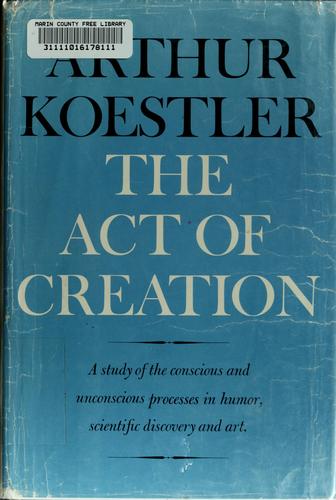
Talk to The Act of Creation like its author wrote you back.
Get the ideas that fit your life — not generic summaries.
- Chat with the book
- Audiobook-style main ideas
- Adapts to your life and goals
- Helps you take action
What it argues
The Act of Creation is Arthur Koestler's attempt to build a unified theory of creativity that accounts for humor, scientific discovery, and artistic originality under a single conceptual framework. Published in 1964, it is one of the most ambitious books written on the psychology of the creative act, and one of the most demanding: at roughly 750 pages across three parts, it is encyclopedic in scope and draws on literature, neuroscience, biology, and philosophy in roughly equal measure.
Koestler's central concept is "bisociation" — the collision of two incompatible matrices of thought that, when brought together, produce something new. He distinguishes this from ordinary "associative" thinking, which moves within a single framework. In humor, the collision produces laughter: two trains of thought intersect at an unexpected junction, releasing tension. In discovery, the same collision produces an "Ah-ha!" moment: two previously separate domains suddenly illuminate each other. In art, it produces the "Ah!" of aesthetic experience. Koestler's argument is that these three responses — Ha! Ah-ha! Ah! — are the signatures of the same underlying cognitive event, and that creativity is fundamentally about the productive collision of previously unconnected mental frameworks.
What it gets right
- 1.
Bisociation is Koestler's term for the collision of two previously separate matrices of thought. He argues this is the cognitive mechanism underlying humor, scientific discovery, and artistic creation.
- 2.
The three responses to bisociation — Ha!, Ah-ha!, and Ah! — correspond to humor, scientific discovery, and aesthetic experience. Koestler argues these are signatures of the same underlying mental event.
- 3.
Ordinary thinking is associative — it moves within a single established framework. Creative thinking crosses frameworks, which is why genuine originality is rare and surprising.
What it covers
Who wrote it
Arthur Koestler was a Hungarian-British author and intellectual whose work spanned fiction, history of science, political commentary, and psychology. Born in Budapest in 1905, he is perhaps best known for his novel Darkness at Noon (1940), a devastating portrait of Stalinist show trials drawn from his own experience as a former Communist. He later turned to the history of science and creativity, producing The Sleepwalkers (1959) and The Act of Creation (1964). Koestler was a fellow of the Royal Society of Literature and received numerous honors. He died in 1983.
