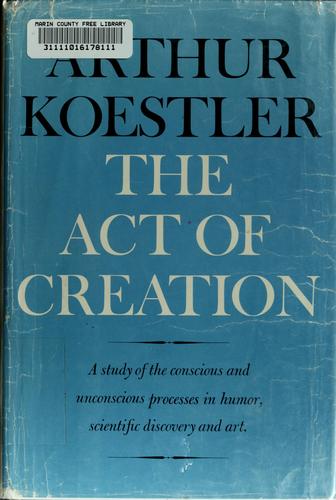
The Act of Creation by Arthur Koestler is a 1964 psychology book about creativity, humor, discovery. Bisociation is Koestler's term for the collision of two previously separate matrices of thought. He argues this is the cognitive mechanism underlying humor, scientific discovery, and artistic creation.
Summary
The Act of Creation is Arthur Koestler's attempt to build a unified theory of creativity that accounts for humor, scientific discovery, and artistic originality under a single conceptual framework. Published in 1964, it is one of the most ambitious books written on the psychology of the creative act, and one of the most demanding: at roughly 750 pages across three parts, it is encyclopedic in scope and draws on literature, neuroscience, biology, and philosophy in roughly equal measure.
Koestler's central concept is "bisociation" — the collision of two incompatible matrices of thought that, when brought together, produce something new. He distinguishes this from ordinary "associative" thinking, which moves within a single framework. In humor, the collision produces laughter: two trains of thought intersect at an unexpected junction, releasing tension. In discovery, the same collision produces an "Ah-ha!" moment: two previously separate domains suddenly illuminate each other. In art, it produces the "Ah!" of aesthetic experience. Koestler's argument is that these three responses — Ha! Ah-ha! Ah! — are the signatures of the same underlying cognitive event, and that creativity is fundamentally about the productive collision of previously unconnected mental frameworks.
Part One, "The Jester," develops the theory through an extended analysis of humor. Koestler is more interested in why jokes work than in making you laugh, and the analysis is rigorous if dry. Part Two, "The Sage," turns to scientific discovery — Kepler, Archimedes, Darwin — and traces the same bisociative pattern in intellectual breakthroughs. Part Three, "The Artist," applies the framework to visual art, music, and literature. Throughout, Koestler is not just proposing a definition but building a mechanistic account of what happens cognitively when something genuinely new is created.
The book's ambition is both its strength and its weakness. The breadth of coverage is genuinely impressive and the core insight is fertile. But the density can be punishing, and Koestler's biological and neurological claims have dated. Later research in cognitive science has both confirmed some of his intuitions and complicated others significantly. Readers willing to engage with the argument selectively — treating the theory as a rich heuristic rather than a complete scientific account — will find it extraordinarily stimulating. It remains one of the most serious attempts by a literary intellectual to crack the problem of originality.
Talk to The Act of Creation like its author wrote you back.
Get the ideas that fit your life — not generic summaries.
- Chat with the book
- Audiobook-style main ideas
- Adapts to your life and goals
- Helps you take action
Key takeaways
- 1.
Bisociation is Koestler's term for the collision of two previously separate matrices of thought. He argues this is the cognitive mechanism underlying humor, scientific discovery, and artistic creation.
- 2.
The three responses to bisociation — Ha!, Ah-ha!, and Ah! — correspond to humor, scientific discovery, and aesthetic experience. Koestler argues these are signatures of the same underlying mental event.
- 3.
Ordinary thinking is associative — it moves within a single established framework. Creative thinking crosses frameworks, which is why genuine originality is rare and surprising.
- 4.
Koestler analyzes humor rigorously as a form of thought rather than just entertainment. The bisociative collision in a joke releases tension via laughter; remove either matrix and the joke dies.
- 5.
Scientific breakthroughs almost always involve importing a concept from one domain into another. Kepler applied harmonic music theory to planetary orbits; Darwin applied Malthusian economics to natural variation.
- 6.
The artistic and the scientific creative acts share a deep structure, even though they look and feel different. Both involve collision between frameworks; the difference is in what the collision is meant to produce.
- 7.
Creative blocks often occur when a thinker is too thoroughly inside a single matrix to see outside it. Koestler's implication is that breadth of exposure to different disciplines reduces creative stagnation.
- 8.
The book's biological theory of creativity, involving 'holons' (wholes that are also parts of larger wholes), was ahead of its time in some respects and now reads as speculative in others — treat it as a framework to think with, not a scientific result.
Discussion questions
Use these on your own, with a book club, or as chat starters in Superbook. Book club version, ready to copy or print →
- 1.
Koestler argues that humor, scientific discovery, and artistic creation share the same underlying cognitive mechanism. Does that unification feel right to you, or does it smooth over real differences?
- 2.
Think of a creative idea you've had or seen. Can you identify the two 'matrices' that collided to produce it? Does the bisociation model fit?
- 3.
Koestler believes genuine originality is rare because most thinking stays within a single framework. What domains or habits have expanded your own repertoire of matrices?
- 4.
The book treats humor as a serious cognitive event rather than mere entertainment. Does analyzing why jokes work intellectually make them more interesting or kill the fun?
- 5.
Koestler's scientific cases — Kepler, Darwin, Archimedes — are all famous breakthroughs. Do you think bisociation is equally present in smaller, everyday creative acts?
- 6.
The density and length of this book make it demanding. Is there an argument that the best books on creativity should themselves model the creative energy they describe? Does this one?
- 7.
How does Koestler's framework relate to analogical reasoning — the way experts transfer patterns from one domain to another? Are these the same thing?
- 8.
Koestler wrote this in 1964. Which parts of the neurological and biological theory have aged most poorly, and what would you replace them with using what we know now?
- 9.
Part Three on art and aesthetics is the most contested part of the book. Does Koestler's framework add anything to your understanding of why certain art moves you?
- 10.
The 'holon' concept — things that are simultaneously wholes and parts of larger wholes — appears throughout the book. Do you find it useful as a way of thinking about complex systems?
- 11.
If bisociation is the key to creativity, what are the practical implications for how you'd organize your intellectual life — your reading, your conversations, your work?
Themes
Frequently asked questions
-
Is The Act of Creation worth reading today?
For serious students of creativity, yes — the bisociation framework is genuinely illuminating and the breadth of case studies is remarkable. The caveat is its length and density. Many readers find the first section on humor and Part Two on scientific discovery more rewarding than the full text.
-
How long is The Act of Creation?
Around 750 pages in most editions, making it one of the longer books on creativity. At average reading pace, expect 12 to 16 hours. It's organized into three distinct parts, so many readers approach it in stages rather than straight through.
-
What is bisociation?
Koestler's term for the creative collision of two previously separate frames of reference or 'matrices.' When two incompatible trains of thought suddenly intersect, the resulting tension is released as humor (laughter), discovery (insight), or aesthetic experience (emotion). The collision — not association within a single framework — is the source of originality.
-
How does this book compare to Mihaly Csikszentmihalyi's work on creativity?
Csikszentmihalyi focuses on the conditions and experience of the creative state — what flow feels like and what circumstances produce it. Koestler's interest is in the underlying cognitive mechanism of the creative act itself. Both are useful; they address different questions about the same phenomenon.
-
Who should read The Act of Creation?
Writers, scientists, designers, and anyone who thinks systematically about where new ideas come from. Also useful for educators interested in how to teach creative thinking. Readers looking for a quick or practical guide should look elsewhere — this book demands patience and rewards it.
Similar books
Creativity, Inc.: Overcoming the Unseen Forces That Stand in the Way of True Inspiration
Ed Catmull and Amy Wallace
The War of Art
Steven Pressfield
Flow: The Psychology of Optimal Experience
Mihaly Csikszentmihalyi
Thinking, Fast and Slow
Daniel Kahneman
