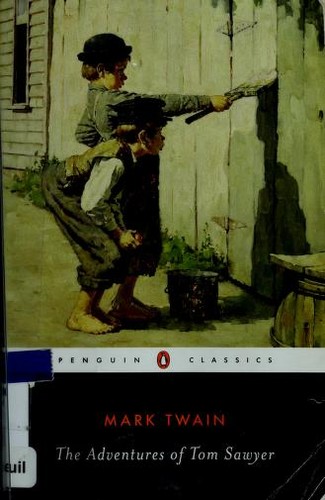
Talk to The Adventures of Tom Sawyer like its author wrote you back.
Get the ideas that fit your life — not generic summaries.
- Chat with the book
- Audiobook-style main ideas
- Adapts to your life and goals
- Helps you take action
The Adventures of Tom Sawyer, in detail
The Adventures of Tom Sawyer is set in the fictional St. Petersburg, Missouri — modeled on Twain's own boyhood town of Hannibal — and follows an irrepressible, imaginative boy who would rather play pirates than attend school, who can charm his friends into whitewashing a fence on his behalf, and who pursues the village schoolteacher's daughter Becky Thatcher with the same theatrical commitment he brings to everything else. The novel was published in 1876 and was one of the first major American novels about childhood from a child's perspective.
The book is funny, affectionate, and deeply observant of how children experience the world — with a terror of boredom, an intense concern for fairness, a flair for drama, and a moral compass that points more reliably than most adults give children credit for. When Tom witnesses a murder in the graveyard and becomes afraid to testify, his eventual choice to do the right thing arrives not from external pressure but from an internal reckoning he cannot escape. Twain takes that reckoning seriously.
The novel works on two levels simultaneously: as a comic adventure story for young readers, and as a satirical portrait of small-town American life in the antebellum era. The adults in the book — the pious, the hypocritical, the self-important — are sketched with a gentle but unmistakable edge. Tom's world looks more vivid and more real than the official version the grown-ups maintain.
This is the lighter, more accessible Twain — nowhere near the moral complexity of Huckleberry Finn, which grew from these same characters and settings. Readers who come expecting that depth will find something more playful and less troubling. That's not a diminishment: the pleasure Tom Sawyer offers is real, and its portrait of how childhood imagination shapes moral character is more substantive than its reputation as a children's book suggests.
The big ideas
- 1.
Tom's famous fence-whitewashing scene is a study in social psychology: he makes the chore desirable by pretending it's a privilege, and Twain's narrator makes clear this is a genuine insight about human nature.
- 2.
The novel takes children's inner lives seriously — their terror of boredom, their code of honor, their capacity for guilt — in a way that was unusual in American fiction of the period.
- 3.
Tom's eventual decision to testify about the murder in the graveyard is the novel's moral center. It arrives because he can't bear the internal cost of silence, not because an adult pressures him.
