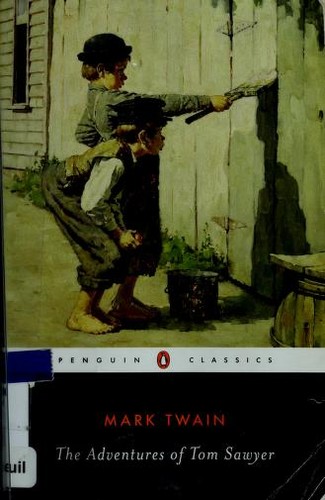
The Adventures of Tom Sawyer by Mark Twain is a 1876 literary fiction book about childhood and freedom, social conformity, conscience and guilt. Tom's famous fence-whitewashing scene is a study in social psychology: he makes the chore desirable by pretending it's a privilege, and Twain's narrator makes clear this is a genuine insight about human nature.
Summary
The Adventures of Tom Sawyer is set in the fictional St. Petersburg, Missouri — modeled on Twain's own boyhood town of Hannibal — and follows an irrepressible, imaginative boy who would rather play pirates than attend school, who can charm his friends into whitewashing a fence on his behalf, and who pursues the village schoolteacher's daughter Becky Thatcher with the same theatrical commitment he brings to everything else. The novel was published in 1876 and was one of the first major American novels about childhood from a child's perspective.
The book is funny, affectionate, and deeply observant of how children experience the world — with a terror of boredom, an intense concern for fairness, a flair for drama, and a moral compass that points more reliably than most adults give children credit for. When Tom witnesses a murder in the graveyard and becomes afraid to testify, his eventual choice to do the right thing arrives not from external pressure but from an internal reckoning he cannot escape. Twain takes that reckoning seriously.
The novel works on two levels simultaneously: as a comic adventure story for young readers, and as a satirical portrait of small-town American life in the antebellum era. The adults in the book — the pious, the hypocritical, the self-important — are sketched with a gentle but unmistakable edge. Tom's world looks more vivid and more real than the official version the grown-ups maintain.
This is the lighter, more accessible Twain — nowhere near the moral complexity of Huckleberry Finn, which grew from these same characters and settings. Readers who come expecting that depth will find something more playful and less troubling. That's not a diminishment: the pleasure Tom Sawyer offers is real, and its portrait of how childhood imagination shapes moral character is more substantive than its reputation as a children's book suggests.
Talk to The Adventures of Tom Sawyer like its author wrote you back.
Get the ideas that fit your life — not generic summaries.
- Chat with the book
- Audiobook-style main ideas
- Adapts to your life and goals
- Helps you take action
Key takeaways
- 1.
Tom's famous fence-whitewashing scene is a study in social psychology: he makes the chore desirable by pretending it's a privilege, and Twain's narrator makes clear this is a genuine insight about human nature.
- 2.
The novel takes children's inner lives seriously — their terror of boredom, their code of honor, their capacity for guilt — in a way that was unusual in American fiction of the period.
- 3.
Tom's eventual decision to testify about the murder in the graveyard is the novel's moral center. It arrives because he can't bear the internal cost of silence, not because an adult pressures him.
- 4.
Injun Joe, the novel's villain, is a genuinely frightening figure whose menace Twain does not dilute — the book is more unsettling than its cheerful reputation suggests.
- 5.
Twain's portrait of village religion, schoolroom education, and civic ceremony is gently satirical throughout, presenting official life as performance and children's secret world as more authentic.
- 6.
The adventures of Tom and Huck in McDougal's Cave, while entertaining, are also the novel's most direct engagement with real danger — the boys are genuinely lost, and Twain doesn't pretend otherwise.
- 7.
Tom Sawyer reads today as prologue: it establishes a world and set of characters that Huckleberry Finn will push into far more morally complex territory.
Discussion questions
Use these on your own, with a book club, or as chat starters in Superbook. Book club version, ready to copy or print →
- 1.
The whitewashing scene is one of the most quoted passages in American literature. Is Tom a manipulator, an entrepreneur, or just a resourceful kid — and does the distinction matter?
- 2.
Tom is simultaneously a conformist (he wants approval, he wants Becky, he wants to be seen as a hero) and a rebel. How does Twain hold those two things together?
- 3.
The novel is often described as a children's book, but Twain wrote it partly as satire of adult life. Which reading do you think is more true to the text?
- 4.
Huck Finn is already present in this novel as the town's social outcast, the boy whose freedom Tom envies. How does his characterization here differ from his characterization in Huckleberry Finn?
- 5.
Tom decides to testify against Injun Joe despite real fear of retaliation. What makes him capable of that, when he is otherwise fairly self-serving?
- 6.
The adults in the novel — Aunt Polly, the Sunday school teachers, Judge Thatcher — are drawn with a kind of fond condescension. Does that feel accurate to you, or is Twain letting them off too easily?
- 7.
The scenes in McDougal's Cave are genuinely tense. Did you find Tom's adventure frightening, or does the tone of the novel prevent you from taking the danger seriously?
- 8.
Tom's relationship with Becky follows a pattern of theatrical pursuit, betrayal, and reconciliation. Is there anything in it that feels emotionally true, or is it purely comic?
- 9.
Injun Joe is the novel's villain and is drawn with racial prejudice that was typical of the period. How do you read the character now, and what does his presence do to the novel?
- 10.
By the end of the novel, Tom is being held up as a model for the local boys. Is that a satisfying ending, or does it domesticate something the novel has been celebrating?
- 11.
Would you give this novel to a ten-year-old today? What would you want them to notice that they might miss?
Themes
Frequently asked questions
-
Is The Adventures of Tom Sawyer worth reading as an adult?
Yes, especially if you haven't read it since childhood. The comedy holds up, and the satirical portrait of small-town American life and official piety is sharper than you might remember. It is lighter and more optimistic than Huckleberry Finn, but not without substance.
-
Is this a children's book?
Twain wrote it as both a children's book and a book for adults who remember being children. The adventure story works for young readers; the satire of adult hypocrisy and village life works better for older ones. It operates on both levels at once.
-
Do I need to read Tom Sawyer before Huckleberry Finn?
No. Huckleberry Finn stands completely on its own and is the greater book. Tom Sawyer enriches Huck by giving context, but starting with Huck is fine. If you read them in order, Tom Sawyer will feel like an optimistic draft for the much darker sequel.
-
What is the whitewashing scene about?
Tom is ordered to whitewash Aunt Polly's fence as punishment and hits on the idea of convincing his friends that painting a fence is a rare privilege. Twain's narrator frames this as a genuine discovery about human psychology: people want what they think others want.
-
Who shouldn't read The Adventures of Tom Sawyer?
Readers expecting the moral complexity and narrative ambition of Huckleberry Finn will find Tom Sawyer too light. The racial characterization of Injun Joe is troubling, and unlike Huckleberry Finn, the novel doesn't examine its own assumptions about race. Go in with calibrated expectations.
Similar books
Adventures of Huckleberry Finn
Mark Twain
Born a Crime: Stories from a South African Childhood
Trevor Noah

The Glass Castle: A Memoir
Jeannette Walls
This Boy's Life
Tobias Wolff
