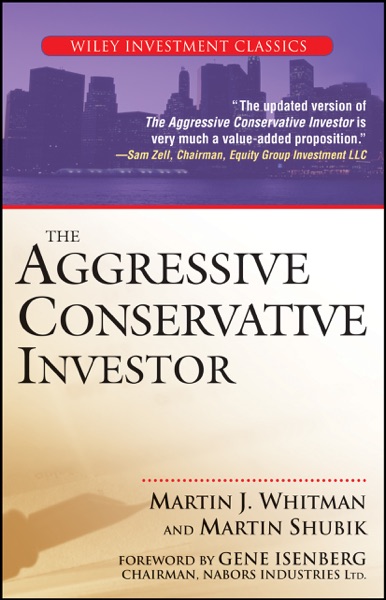
Talk to The Aggressive Conservative Investor like its author wrote you back.
Get the ideas that fit your life — not generic summaries.
- Chat with the book
- Audiobook-style main ideas
- Adapts to your life and goals
- Helps you take action
What it argues
The Aggressive Conservative Investor lays out Martin Whitman's distinctive approach to securities analysis, which he developed over decades as a distressed-debt investor and fund manager before founding Third Avenue Management. The central premise sounds paradoxical: you can be both aggressive in seeking returns and conservative in managing risk, because the two goals converge when you buy financially strong businesses at substantial discounts to net asset value. The aggression is in pursuing opportunities others overlook; the conservatism is in the quality of the underlying businesses you own.
Whitman's framework is fundamentally asset-based rather than earnings-based. Where most investors discount future cash flows or focus on earnings multiples, Whitman starts with what a business owns and owes — its balance sheet — and looks for situations where publicly traded securities sell for meaningfully less than the underlying net asset value. This is Graham and Dodd extended: Whitman takes the balance-sheet orientation further, applies it to more complex situations including distressed companies, and develops a more systematic treatment of the financial conditions that make a company "safe and cheap."
What it gets right
- 1.
The aggressive conservative investor seeks assets at large discounts to net asset value in companies with sound financial condition — the aggression is in the pursuit, the conservatism is in the balance sheet quality required.
- 2.
Asset-based analysis is more reliable than earnings-based analysis for many situations. Earnings are subject to manipulation and cyclicality; a carefully analyzed balance sheet is harder to fake.
- 3.
Financial strength is a precondition, not an afterthought. Whitman focuses on companies with strong balance sheets, low leverage, and real assets — owning a great business bought badly can still destroy wealth.
What it covers
Who wrote it
Martin J. Whitman is the founder of Third Avenue Management and one of the foremost practitioners of distressed and value investing over the second half of the twentieth century. Before Third Avenue he spent decades as a restructuring adviser, gaining hands-on knowledge of how companies look from inside financial stress. His other books include Value Investing: A Balanced Approach. Martin Shubik was a game theorist and economist at Yale; Gene Isenberg was a businessman and investor. The book reflects Whitman's primary analytical framework, developed through practice rather than academic theory.
