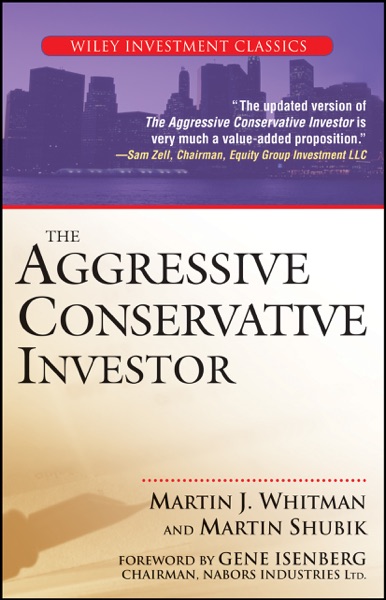
The Aggressive Conservative Investor by Martin J. Whitman, Martin Shubik & Gene Isenberg is a 1979 economics book about value investing, financial analysis, asset-based investing. The aggressive conservative investor seeks assets at large discounts to net asset value in companies with sound financial condition — the aggression is in the pursuit, the conservatism is in the balance sheet quality required.
Summary
The Aggressive Conservative Investor lays out Martin Whitman's distinctive approach to securities analysis, which he developed over decades as a distressed-debt investor and fund manager before founding Third Avenue Management. The central premise sounds paradoxical: you can be both aggressive in seeking returns and conservative in managing risk, because the two goals converge when you buy financially strong businesses at substantial discounts to net asset value. The aggression is in pursuing opportunities others overlook; the conservatism is in the quality of the underlying businesses you own.
Whitman's framework is fundamentally asset-based rather than earnings-based. Where most investors discount future cash flows or focus on earnings multiples, Whitman starts with what a business owns and owes — its balance sheet — and looks for situations where publicly traded securities sell for meaningfully less than the underlying net asset value. This is Graham and Dodd extended: Whitman takes the balance-sheet orientation further, applies it to more complex situations including distressed companies, and develops a more systematic treatment of the financial conditions that make a company "safe and cheap."
The book is also a sustained argument against the Efficient Market Hypothesis as then taught in business schools. Whitman and his co-authors contend that markets are frequently irrational in individual securities, that the academic framework produces dangerously complacent analysis, and that hands-on fundamental analysis of specific businesses routinely reveals mispricings that a theory of market efficiency cannot explain. Written in 1979, the argument has aged well: the subsequent decades of professional value investing largely vindicated the critique.
The writing is demanding. This is not a popularization but a practitioner's manual, and it assumes familiarity with accounting and financial statements. Readers accustomed to the clear prose of later value investing books may find it harder going. But for serious investors willing to work through it, the conceptual precision is the point. Whitman draws distinctions — between earnings quality, book value quality, and the conditions that constitute genuine financial strength — that most investment literature blurs. The book rewards careful reading and repays revisiting as your own analytical toolkit develops.
Talk to The Aggressive Conservative Investor like its author wrote you back.
Get the ideas that fit your life — not generic summaries.
- Chat with the book
- Audiobook-style main ideas
- Adapts to your life and goals
- Helps you take action
Key takeaways
- 1.
The aggressive conservative investor seeks assets at large discounts to net asset value in companies with sound financial condition — the aggression is in the pursuit, the conservatism is in the balance sheet quality required.
- 2.
Asset-based analysis is more reliable than earnings-based analysis for many situations. Earnings are subject to manipulation and cyclicality; a carefully analyzed balance sheet is harder to fake.
- 3.
Financial strength is a precondition, not an afterthought. Whitman focuses on companies with strong balance sheets, low leverage, and real assets — owning a great business bought badly can still destroy wealth.
- 4.
The Efficient Market Hypothesis, as taught in business schools, leads to sloppy analysis. Markets are often efficient on average but routinely mispriced in individual securities, especially when situations are complex or distressed.
- 5.
Earnings per share is one of the most misleading metrics in investing. It depends heavily on accounting choices, ignores balance-sheet health, and says nothing about the resources required to produce those earnings.
- 6.
Distressed and complex situations are often the richest source of value opportunities precisely because they require more analytical work than most investors are willing to do.
- 7.
Investment returns and investment safety are not opposites. Buying at a large discount to net asset value reduces both downside risk and competes favorably against optimistic earnings-based valuations.
- 8.
Quality of assets matters as much as quantity. Real property, cash, and marketable securities are more reliable anchors to value than goodwill, intangibles, or capitalized R&D.
Discussion questions
Use these on your own, with a book club, or as chat starters in Superbook. Book club version, ready to copy or print →
- 1.
Whitman argues asset-based analysis is more reliable than earnings-based analysis. In what kinds of businesses does this hold most strongly, and where does it break down?
- 2.
The 'aggressive conservative' label resolves a false dichotomy. Where else in investing or business do you think people create false tradeoffs between risk and return?
- 3.
Whitman was deeply skeptical of Modern Portfolio Theory and the Efficient Market Hypothesis. How have the decades since 1979 shaped or complicated his critique?
- 4.
The book assumes serious accounting literacy. Do you think that requirement is a feature or a limitation — does good investing require being a good accountant?
- 5.
Whitman's framework is built around net asset value. What are the hardest parts of balance-sheet analysis — the places where book value most diverges from economic reality?
- 6.
Distressed investing requires holding unpopular positions for long periods. What temperamental or institutional factors make this hardest, and how do successful practitioners manage them?
- 7.
Whitman distinguishes between good businesses bought at any price and businesses with sound financial condition bought cheaply. How do you weigh business quality versus price in your own framework?
- 8.
The book was written in 1979. How have changes in accounting standards, financial instruments, and market structure changed the applicability of Whitman's framework?
- 9.
Whitman is skeptical of EPS as a metric. What alternative metrics does he prefer, and do you find those more or less useful in the businesses you analyze?
- 10.
Asset-based investing tends to work better in asset-heavy industries. How do you apply the underlying principles to knowledge businesses or software companies with few tangible assets?
- 11.
The book argues that complex situations create opportunity. Do you think information is more or less the edge in today's markets versus Whitman's era?
Themes
Frequently asked questions
-
Is The Aggressive Conservative Investor still relevant today?
The framework is durable because balance sheets haven't changed. Asset-based analysis, the critique of EPS, and the argument for financial-strength-as-precondition all hold. Some market mechanics differ, but the conceptual foundation is as useful now as in 1979.
-
How difficult is this book to read?
It's demanding. Whitman assumes comfort with financial statements and accounting concepts. Readers without that background will struggle. For serious investors, the density is a feature — the precision you gain from working through it carefully is part of the payoff.
-
What makes Whitman's approach different from Benjamin Graham's?
Whitman extends Graham's balance-sheet orientation into more complex situations — distressed companies, special situations, international securities. He's also more explicit about financial strength as a required condition, not just a preference. The underlying philosophy is similar but the application is wider and more nuanced.
-
Who should read this book?
Serious individual investors and professionals who want to understand asset-based valuation rigorously. Not for beginners or readers looking for simple rules. Most useful for those already familiar with Graham and Dodd who want a more systematic treatment of financial condition analysis.
-
What is the core actionable idea?
Buy financially strong businesses — sound balance sheets, real assets, low leverage — when their publicly traded securities sell at a meaningful discount to net asset value. The two conditions together (quality plus price) provide both safety and return.