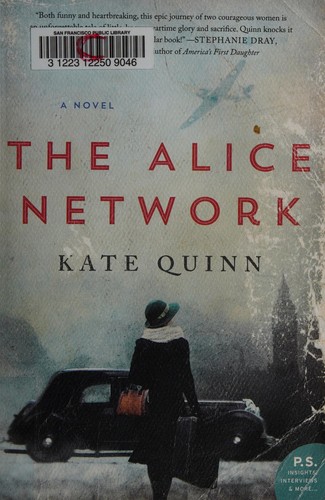
Talk to The Alice Network like its author wrote you back.
Get the ideas that fit your life — not generic summaries.
- Chat with the book
- Audiobook-style main ideas
- Adapts to your life and goals
- Helps you take action
The Alice Network, in detail
The Alice Network alternates between two timelines and two women. In 1947, American college student Charlie St. Clair is traveling through postwar Europe to find her missing cousin Rose, who disappeared somewhere in France during the German occupation. Charlie ends up on the doorstep of Eve Gardiner, a former British spy with damaged hands, a drinking problem, and a deep reluctance to revisit her past. What follows is a road trip through occupied memories and literal geography, as Eve's wartime story — how she worked as a spy inside a German-run French restaurant network during World War One — unfolds in parallel chapters set in 1915.
The book is at its best when it's about what espionage actually does to people. Eve's story involves sexual coercion, surveillance, betrayal, and the slow torture of playing a role while watching people you care about die. Quinn doesn't glamorize it. The Alice Network — a real historical network of female spies in occupied France — is used as both historical scaffold and moral argument: these women were used and discarded, and the men who commanded them moved on while the women lived with what had been asked of them.
The dual-timeline structure is Quinn's signature, and she handles it with practiced efficiency. The 1915 chapters carry more weight — Eve's voice is sharper, the stakes feel higher, and the villain (a real historical figure) is genuinely threatening. The 1947 sections are warmer and more conventionally satisfying but occasionally feel like the lesser of the two narratives. Quinn writes propulsive, detail-rich prose; the historical research is evident without being obtrusive.
This is popular historical fiction at a high level of execution — plot-driven, emotionally engaging, and built on genuine research. Readers who want literary ambiguity and formal experimentation won't find it here. Those who want a gripping dual-timeline novel about women in wartime, told with clarity and momentum and a satisfying ending, will get exactly what they came for.
The big ideas
- 1.
The Alice Network was a real historical spy network run by Louise de Bettignies in occupied France during WWI — Quinn uses it as a lens for examining how female espionage was exploited and then forgotten.
- 2.
Eve's damaged hands are the novel's central physical metaphor — what war extracts from the body, and how survivors carry the evidence of what was done to them.
- 3.
The dual-timeline structure allows Quinn to let each woman's story comment on the other — Charlie's search in 1947 gains meaning from what we know about Eve's losses in 1915.
