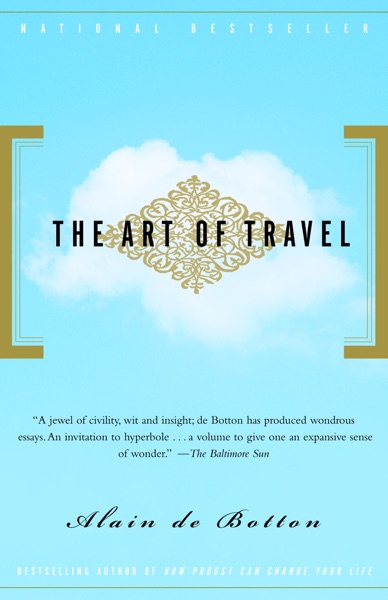
Talk to The Art of Travel like its author wrote you back.
Get the ideas that fit your life — not generic summaries.
- Chat with the book
- Audiobook-style main ideas
- Adapts to your life and goals
- Helps you take action
The Art of Travel, in detail
The Art of Travel is Alain de Botton's philosophical meditation on why we travel, what we hope to find, and the gap between anticipation and experience. De Botton is a Swiss-British writer known for applying philosophical thinking to everyday life, and this book follows that pattern: each chapter pairs a destination (Barbados, Amsterdam, Provence, Sinai) with a guide drawn from art or philosophy (Baudelaire, Ruskin, Wordsworth, Flaubert), using the combination to examine a single aspect of travel—anticipation, curiosity, the sublime, art.
The book opens with an argument familiar to anyone who has returned disappointed from a vacation: we imagine places as transformative, arrive to find ourselves still ourselves, and conclude that we somehow failed the destination. De Botton's argument is different—that our expectations fail to account for our own presence in the scene, for the distractions and small discomforts that follow us wherever we go. The guide for this section is the nineteenth-century writer Xavier de Maistre, who wrote a celebrated account of traveling around his bedroom, suggesting that attention, not location, is what actually matters.
Subsequent chapters take different angles. Flaubert's obsession with the exotic becomes a lens on why remote places attract us. Wordsworth's Alpine walks examine the restorative power of natural scenery and the conditions under which it actually works. Ruskin's architectural notebooks are the occasion for an argument that learning to draw teaches you to see, and that seeing—genuinely seeing what's in front of you—is the underrated skill that determines whether travel produces anything worth keeping.
The book's weakness, frequently noted, is its solipsism: de Botton's travel companions, when they appear at all, are barely present, and the aesthetic experience he describes is relentlessly upper-middle-class in its presumptions. These are real criticisms, but the philosophical substance survives them. The central insight—that the quality of travel depends more on the quality of attention than on the quality of destination—is one that most travel writing avoids in favor of the destination itself.
The big ideas
- 1.
The gap between anticipating a trip and arriving on it is one of the most reliable facts of travel. We imagine places without imagining ourselves in them, and ourselves without our ordinary moods and preoccupations.
- 2.
Xavier de Maistre's lesson: attention transforms experience. Traveling around one's bedroom, practiced with enough concentration, can produce more than an inattentive trip to a famous site.
- 3.
Flaubert's love of the exotic was not naive escapism but a productive dissatisfaction with the familiar. The desire to be elsewhere can fuel serious creative work, not just restlessness.
