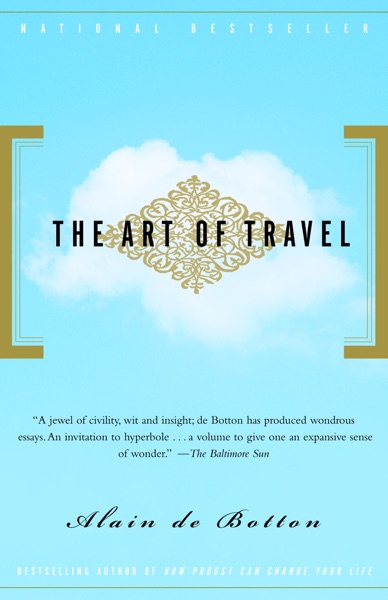
The Art of Travel by Alain de Botton is a 2002 philosophy book about travel, aesthetics, expectation. The gap between anticipating a trip and arriving on it is one of the most reliable facts of travel. We imagine places without imagining ourselves in them, and ourselves without our ordinary moods and preoccupations.
Summary
The Art of Travel is Alain de Botton's philosophical meditation on why we travel, what we hope to find, and the gap between anticipation and experience. De Botton is a Swiss-British writer known for applying philosophical thinking to everyday life, and this book follows that pattern: each chapter pairs a destination (Barbados, Amsterdam, Provence, Sinai) with a guide drawn from art or philosophy (Baudelaire, Ruskin, Wordsworth, Flaubert), using the combination to examine a single aspect of travel—anticipation, curiosity, the sublime, art.
The book opens with an argument familiar to anyone who has returned disappointed from a vacation: we imagine places as transformative, arrive to find ourselves still ourselves, and conclude that we somehow failed the destination. De Botton's argument is different—that our expectations fail to account for our own presence in the scene, for the distractions and small discomforts that follow us wherever we go. The guide for this section is the nineteenth-century writer Xavier de Maistre, who wrote a celebrated account of traveling around his bedroom, suggesting that attention, not location, is what actually matters.
Subsequent chapters take different angles. Flaubert's obsession with the exotic becomes a lens on why remote places attract us. Wordsworth's Alpine walks examine the restorative power of natural scenery and the conditions under which it actually works. Ruskin's architectural notebooks are the occasion for an argument that learning to draw teaches you to see, and that seeing—genuinely seeing what's in front of you—is the underrated skill that determines whether travel produces anything worth keeping.
The book's weakness, frequently noted, is its solipsism: de Botton's travel companions, when they appear at all, are barely present, and the aesthetic experience he describes is relentlessly upper-middle-class in its presumptions. These are real criticisms, but the philosophical substance survives them. The central insight—that the quality of travel depends more on the quality of attention than on the quality of destination—is one that most travel writing avoids in favor of the destination itself.
Talk to The Art of Travel like its author wrote you back.
Get the ideas that fit your life — not generic summaries.
- Chat with the book
- Audiobook-style main ideas
- Adapts to your life and goals
- Helps you take action
Key takeaways
- 1.
The gap between anticipating a trip and arriving on it is one of the most reliable facts of travel. We imagine places without imagining ourselves in them, and ourselves without our ordinary moods and preoccupations.
- 2.
Xavier de Maistre's lesson: attention transforms experience. Traveling around one's bedroom, practiced with enough concentration, can produce more than an inattentive trip to a famous site.
- 3.
Flaubert's love of the exotic was not naive escapism but a productive dissatisfaction with the familiar. The desire to be elsewhere can fuel serious creative work, not just restlessness.
- 4.
Wordsworth showed that restorative experiences in nature require preparation — the right frame of mind, the right pace, some willingness to be still. They don't happen automatically.
- 5.
Ruskin argued that drawing teaches seeing. The act of trying to represent what's in front of you forces a quality of attention that looking alone almost never produces.
- 6.
De Botton argues that art—paintings, novels, poems—can be a form of travel preparation that works better than guidebooks, because it shapes what we're capable of noticing.
- 7.
The sublime experience—encountering landscape at a scale that dwarfs the self—has a specific psychological function: it temporarily quiets the ego's preoccupations by confronting them with something genuinely larger.
Discussion questions
Use these on your own, with a book club, or as chat starters in Superbook. Book club version, ready to copy or print →
- 1.
De Botton argues that we travel without imagining ourselves in the destinations we anticipate. Has that been true of your own experience? What did you expect and what did you actually find?
- 2.
The Xavier de Maistre chapter suggests that quality of attention matters more than location. Is there a place in your everyday life you've never really looked at?
- 3.
De Botton uses art and literature to frame each destination. How does reading about a place before visiting change how you experience it, if at all?
- 4.
Ruskin's argument is that drawing teaches seeing. Have you ever done something — drawing, photography, journaling — that changed what you noticed in a new place?
- 5.
The book is often criticized for its solipsism and class assumptions. Does that critique change the value of the philosophical argument for you?
- 6.
What's the most disappointing trip you've taken in terms of the gap between expectation and experience? What do you think caused the gap?
- 7.
De Botton argues that the sublime temporarily quiets ego. Have you had experiences in nature or elsewhere that fit that description? What made them different from ordinary pleasurable experiences?
- 8.
Flaubert was drawn to the exotic as an antidote to bourgeois comfort. Is there a productive version of that dissatisfaction, or does it just produce restlessness?
- 9.
De Botton's travel companions in the book are almost invisible. Is that a philosophical choice or just a blind spot? What does it suggest about the kind of attention he's advocating?
- 10.
If the quality of attention matters more than the destination, what would you do differently before, during, and after a trip?
- 11.
The book was published in 2002, before smartphones and social media changed the visual documentation of travel. Does the argument about attention apply differently in an era when photographing a place is the default mode of engaging with it?
Themes
Frequently asked questions
-
What is The Art of Travel about?
A philosophical examination of why we travel, what we hope to gain from it, and the persistent gap between anticipation and experience. Each chapter pairs a real destination with an artist or thinker — Baudelaire, Ruskin, Wordsworth — to illuminate a different aspect of travel and attention.
-
Is The Art of Travel a travel guide?
No. It will not help you plan a trip. It is a philosophical book about the psychology and aesthetics of travel. If you're looking for recommendations, look elsewhere. If you want to think differently about why you travel, this is the book.
-
Is Alain de Botton's writing style accessible?
Yes. He writes for a general audience, explains philosophical references clearly, and keeps the tone conversational rather than academic. The book is short enough to finish in a weekend.
-
What's the central insight of The Art of Travel?
That the quality of travel depends more on the quality of attention you bring to it than on the destination itself. De Botton draws on Xavier de Maistre, who famously traveled around his bedroom, to make the point that even small, ordinary environments reward genuine attention.
-
Who should read The Art of Travel?
Readers who travel and feel vaguely disappointed by the experience, readers interested in aesthetics and perception, and anyone who enjoys philosophical writing applied to everyday life. It's also a good companion to other de Botton books if you've liked his approach elsewhere.