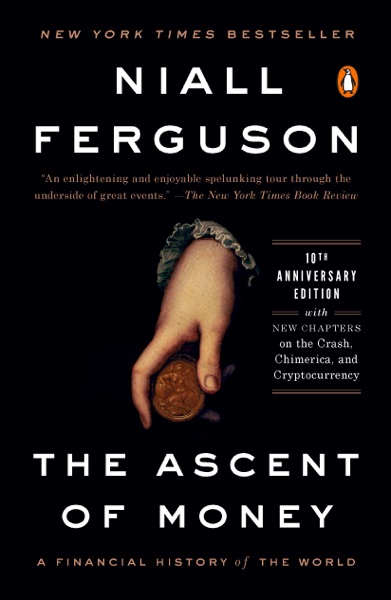
Talk to The Ascent of Money: A Financial History of the World like its author wrote you back.
Get the ideas that fit your life — not generic summaries.
- Chat with the book
- Audiobook-style main ideas
- Adapts to your life and goals
- Helps you take action
The Ascent of Money: A Financial History of the World, in detail
Niall Ferguson published The Ascent of Money in 2008, with timing that turned out to be acute: the book appeared just as the global financial crisis was unfolding, making its subject matter suddenly urgent for readers who had barely thought about the mechanics of credit default swaps or mortgage securitization. The book is a history of financial innovation from ancient Babylon through the Renaissance, the birth of the bond market, the rise of stock companies, the insurance industry, the real estate market, and finally the globalized derivatives markets of the early twenty-first century.
Ferguson's argument is that financial history is not peripheral to human history but central to it. Wars are fought with money; empires are maintained with bond markets; political power follows financial power. The Medicis rose to prominence as bankers; the British Empire was financed through the most sophisticated sovereign bond market of its era; the United States Federal Reserve's actions in 2007–2008 reflected the institutional architecture laid down by earlier financial crises. Understanding the financial system is, on this account, essential to understanding how the modern world came to be.
The chapters move through successive financial innovations: credit and debt, the bond market, the stock market, insurance, real estate, and international finance. Each section traces the origin of the instrument, the crises it has generated, and the way successive crises reshaped the institutions. Ferguson writes with real historical depth — the chapter on the origins of the bond market in Renaissance Florence and the chapter on the Rothschilds are among the most illuminating accounts of financial history available at this length.
The book's limitations are partly a product of its ambition. The narrative breadth means some topics — the derivatives markets, the subprime crisis — are treated more superficially than book-length treatments allow. Ferguson's interpretive framework, which tends toward elite financial history and the agency of great institutions, gives less weight to structural forces and the experience of ordinary people caught in financial crises. His broader political views are visible in the framing at points. But as a readable entry point into financial history, the book remains one of the best available.
The big ideas
- 1.
Financial history is central to world history: wars, empires, and revolutions have all been shaped by the capacity to raise, borrow, and deploy capital.
- 2.
Credit preceded coinage: the first financial instruments were Mesopotamian clay tablets recording debts in grain, antedating metal money by centuries.
- 3.
Bond markets transferred risk from individual investors to the state and then to global markets, enabling governments to fight wars and fund infrastructure at scales previously impossible.
