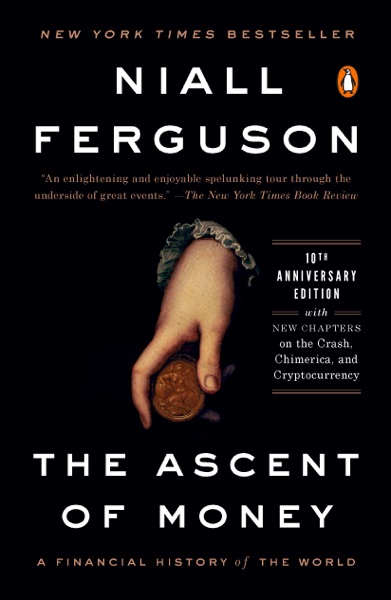
The Ascent of Money: A Financial History of the World by Niall Ferguson is a 2008 economics book about financial history, banking, risk. Financial history is central to world history: wars, empires, and revolutions have all been shaped by the capacity to raise, borrow, and deploy capital.
Summary
Niall Ferguson published The Ascent of Money in 2008, with timing that turned out to be acute: the book appeared just as the global financial crisis was unfolding, making its subject matter suddenly urgent for readers who had barely thought about the mechanics of credit default swaps or mortgage securitization. The book is a history of financial innovation from ancient Babylon through the Renaissance, the birth of the bond market, the rise of stock companies, the insurance industry, the real estate market, and finally the globalized derivatives markets of the early twenty-first century.
Ferguson's argument is that financial history is not peripheral to human history but central to it. Wars are fought with money; empires are maintained with bond markets; political power follows financial power. The Medicis rose to prominence as bankers; the British Empire was financed through the most sophisticated sovereign bond market of its era; the United States Federal Reserve's actions in 2007–2008 reflected the institutional architecture laid down by earlier financial crises. Understanding the financial system is, on this account, essential to understanding how the modern world came to be.
The chapters move through successive financial innovations: credit and debt, the bond market, the stock market, insurance, real estate, and international finance. Each section traces the origin of the instrument, the crises it has generated, and the way successive crises reshaped the institutions. Ferguson writes with real historical depth — the chapter on the origins of the bond market in Renaissance Florence and the chapter on the Rothschilds are among the most illuminating accounts of financial history available at this length.
The book's limitations are partly a product of its ambition. The narrative breadth means some topics — the derivatives markets, the subprime crisis — are treated more superficially than book-length treatments allow. Ferguson's interpretive framework, which tends toward elite financial history and the agency of great institutions, gives less weight to structural forces and the experience of ordinary people caught in financial crises. His broader political views are visible in the framing at points. But as a readable entry point into financial history, the book remains one of the best available.
Talk to The Ascent of Money: A Financial History of the World like its author wrote you back.
Get the ideas that fit your life — not generic summaries.
- Chat with the book
- Audiobook-style main ideas
- Adapts to your life and goals
- Helps you take action
Key takeaways
- 1.
Financial history is central to world history: wars, empires, and revolutions have all been shaped by the capacity to raise, borrow, and deploy capital.
- 2.
Credit preceded coinage: the first financial instruments were Mesopotamian clay tablets recording debts in grain, antedating metal money by centuries.
- 3.
Bond markets transferred risk from individual investors to the state and then to global markets, enabling governments to fight wars and fund infrastructure at scales previously impossible.
- 4.
The stock company was an innovation in risk-sharing: by pooling capital from many investors and limiting each investor's liability, it enabled enterprises too large for any individual to fund.
- 5.
Insurance transforms risk from a lottery into a calculable cost, but depends entirely on the actuarial accuracy of its models — which catastrophic and unprecedented events consistently defeat.
- 6.
Real estate has been the asset class most associated with financial crises because it combines illiquidity, leverage, and the behavioral tendency to assume prices only rise.
- 7.
Financial globalization connects economies in ways that transmit crises across borders, as the 2008 collapse of US mortgage-backed securities simultaneously damaged European banks.
- 8.
Every major financial innovation has eventually been followed by a crisis that exposed its structural weaknesses — the pattern repeats not because we don't know the history but because incentives overwhelm memory.
Discussion questions
Use these on your own, with a book club, or as chat starters in Superbook. Book club version, ready to copy or print →
- 1.
Ferguson argues financial history is central to world history. Which example from the book most changed how you thought about a historical event?
- 2.
The book traces the pattern of innovation followed by crisis across multiple financial instruments. Does this pattern suggest financial crises are inevitable, and if so, what follows from that?
- 3.
Ferguson's coverage of the 2008 crisis was written as it unfolded. How does reading about a financial crisis in historical narrative form change how you understand it compared to news coverage?
- 4.
The bond market chapter shows how state borrowing capacity determines military power. Does that analysis hold in a world of nuclear weapons and economic sanctions?
- 5.
Insurance works by pooling and modeling risk. Where does the model break down, and what does that tell us about the limits of applying financial logic to genuinely uncertain events?
- 6.
Ferguson traces the Rothschild family's role in nineteenth-century finance. What does their story tell us about the relationship between private financial power and political power?
- 7.
Real estate has been the asset at the center of several of history's worst financial crises. Why does housing seem so resistant to the lessons of previous crashes?
- 8.
The stock company limited individual liability to enable large-scale enterprise. What are the arguments for and against limited liability as a feature of corporate structure?
- 9.
Globalized finance connects economies in ways that make crises contagious. What is the tradeoff between the benefits of financial integration and the risk of contagion?
- 10.
Ferguson is a historian who writes about economics. How does his historical method differ from an economist's approach to the same material?
- 11.
Which financial innovation do you think has had the most transformative effect on ordinary people's lives — credit, insurance, pensions, mortgages?
- 12.
The book ends with the 2008 crisis as an unresolved situation. What has the subsequent decade and a half told us about whether the underlying conditions were addressed?
Themes
Frequently asked questions
-
What is The Ascent of Money about?
It is a history of financial innovation from ancient Babylon to the 2008 financial crisis, arguing that financial institutions — credit, bonds, stocks, insurance, real estate markets — are central to world history and that understanding them is essential to understanding how the modern world works.
-
Is The Ascent of Money worth reading?
Yes, particularly for readers with limited background in financial history. The historical sections on the bond market, the Medicis, and the Rothschilds are excellent. The coverage of contemporary finance is thinner than book-length treatments but serviceable as an introduction.
-
How long does it take to read The Ascent of Money?
About six to seven hours. The book is around 340 pages and aimed at a general audience, though some familiarity with basic financial concepts helps with the later chapters on derivatives and securitization.
-
Do you need financial knowledge to read The Ascent of Money?
Basic financial literacy helps but is not required. Ferguson explains key instruments and concepts as they appear. Readers who are already comfortable with how bonds, stocks, and insurance work will move through the book faster.
-
How does The Ascent of Money compare to The Big Short?
The Big Short by Michael Lewis covers the 2008 financial crisis in close narrative detail through specific characters. The Ascent of Money provides a much broader historical context — centuries rather than years — but covers the crisis itself more superficially. They complement each other well.
Similar books
The Big Short: Inside the Doomsday Machine
Michael Lewis
Against the Gods: The Remarkable Story of Risk
Peter L. Bernstein
Why Nations Fail: The Origins of Power, Prosperity, and Poverty
Daron Acemoglu and James A. Robinson
Sapiens: A Brief History of Humankind
Yuval Noah Harari
