Talk to The Bed of Procrustes like its author wrote you back.
Get the ideas that fit your life — not generic summaries.
- Chat with the book
- Audiobook-style main ideas
- Adapts to your life and goals
- Helps you take action
The Bed of Procrustes, in detail
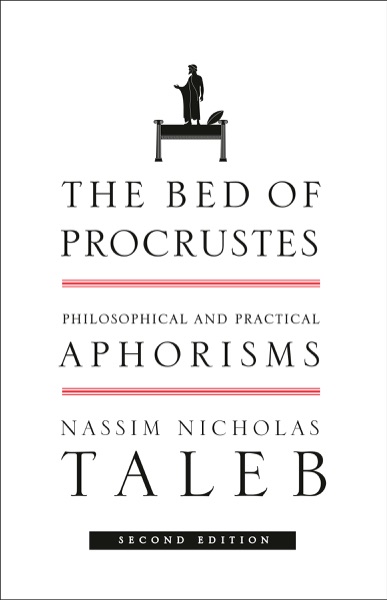
The Bed of Procrustes is Nassim Nicholas Taleb's collection of philosophical aphorisms, the third volume in his Incerto series following Fooled by Randomness and The Black Swan. The title refers to the Greek myth of Procrustes, who adjusted travelers to fit his iron bed—stretching those who were too short, amputating those who were too long. Taleb uses the image to describe the human tendency to distort reality to fit our models and categories rather than adjusting our models to fit reality.
Unlike Taleb's other books, which build extended arguments through narrative and evidence, The Bed of Procrustes makes its case through compression. The aphorisms are organized loosely into sections—on knowledge, on the intelligentsia, on ethics, on randomness, on personal virtue—but there is no linear argument to follow. Each statement stands alone, inviting the reader to either assent, object, or trace out the implications. Some are plainly true and memorably phrased. Others are provocations designed to destabilize a comfortable assumption. Some are merely clever; a few are wrong.
The recurring targets are Taleb's familiar ones: naive intellectuals who mistake academic credentials for understanding, people who confuse absence of evidence for evidence of absence, fragile systems that appear stable until they catastrophically fail, and the specific type of modern expert who has theoretical knowledge without skin in the game. The recurring virtues are epistemic humility, practical wisdom, willingness to act under uncertainty, and the Stoic capacity to accept what cannot be changed.
Reading a collection of aphorisms is a different cognitive activity from reading an argument, and The Bed of Procrustes rewards a different kind of engagement. The best approach is to read it slowly, one section at a time, stopping when something strikes you rather than finishing in one sitting. The weakest readings of Taleb treat his aphorisms as clever Twitter-ready maxims; the strongest engage with the philosophical tradition they're working in—Montaigne, Pascal, Nietzsche—and push back where the compression conceals genuine complexity. The book is a minor work in Taleb's corpus, but a good companion to the major ones.
The big ideas
- 1.
Procrustean thinking distorts observations to fit the model rather than updating the model to fit the observations. Most academic and media analysis commits this error systematically.
- 2.
The intelligentsia—credentialed experts who advise on complex systems—are often less reliable than practitioners with skin in the game, because they bear no consequences for being wrong.
- 3.
Absence of evidence is not evidence of absence. This is a logical principle, but Taleb argues it has deep practical implications for how we think about risk in domains with fat tails.
