The Bed of Procrustes by Nassim Nicholas Taleb is a 2010 philosophy book about aphorisms, epistemology, uncertainty. Procrustean thinking distorts observations to fit the model rather than updating the model to fit the observations. Most academic and media analysis commits this error systematically.
Summary
The Bed of Procrustes is Nassim Nicholas Taleb's collection of philosophical aphorisms, the third volume in his Incerto series following Fooled by Randomness and The Black Swan. The title refers to the Greek myth of Procrustes, who adjusted travelers to fit his iron bed—stretching those who were too short, amputating those who were too long. Taleb uses the image to describe the human tendency to distort reality to fit our models and categories rather than adjusting our models to fit reality.
Unlike Taleb's other books, which build extended arguments through narrative and evidence, The Bed of Procrustes makes its case through compression. The aphorisms are organized loosely into sections—on knowledge, on the intelligentsia, on ethics, on randomness, on personal virtue—but there is no linear argument to follow. Each statement stands alone, inviting the reader to either assent, object, or trace out the implications. Some are plainly true and memorably phrased. Others are provocations designed to destabilize a comfortable assumption. Some are merely clever; a few are wrong.
The recurring targets are Taleb's familiar ones: naive intellectuals who mistake academic credentials for understanding, people who confuse absence of evidence for evidence of absence, fragile systems that appear stable until they catastrophically fail, and the specific type of modern expert who has theoretical knowledge without skin in the game. The recurring virtues are epistemic humility, practical wisdom, willingness to act under uncertainty, and the Stoic capacity to accept what cannot be changed.
Reading a collection of aphorisms is a different cognitive activity from reading an argument, and The Bed of Procrustes rewards a different kind of engagement. The best approach is to read it slowly, one section at a time, stopping when something strikes you rather than finishing in one sitting. The weakest readings of Taleb treat his aphorisms as clever Twitter-ready maxims; the strongest engage with the philosophical tradition they're working in—Montaigne, Pascal, Nietzsche—and push back where the compression conceals genuine complexity. The book is a minor work in Taleb's corpus, but a good companion to the major ones.
Talk to The Bed of Procrustes like its author wrote you back.
Get the ideas that fit your life — not generic summaries.
- Chat with the book
- Audiobook-style main ideas
- Adapts to your life and goals
- Helps you take action
Key takeaways
- 1.
Procrustean thinking distorts observations to fit the model rather than updating the model to fit the observations. Most academic and media analysis commits this error systematically.
- 2.
The intelligentsia—credentialed experts who advise on complex systems—are often less reliable than practitioners with skin in the game, because they bear no consequences for being wrong.
- 3.
Absence of evidence is not evidence of absence. This is a logical principle, but Taleb argues it has deep practical implications for how we think about risk in domains with fat tails.
- 4.
True knowledge shows in what you don't do as much as what you do. Wisdom is visible in restraint, refusal, and the capacity to say 'I don't know.'
- 5.
The modern world's preference for quantifiable, legible information systematically undervalues tacit knowledge that cannot be stated without losing its force.
- 6.
Fragility hides in apparent stability. The things that look most reliable—large institutions, established practices, long-lived arrangements—are often most brittle precisely because their robustness has never been tested.
- 7.
Ethics must be grounded in consequences, not just intentions. Taleb's formulation: a pilot who crashes the plane kills himself alongside his passengers. A doctor who recommends a bad drug rarely faces equivalent consequences.
Discussion questions
Use these on your own, with a book club, or as chat starters in Superbook. Book club version, ready to copy or print →
- 1.
Pick any three aphorisms from the book. What's the strongest objection you can make to each? Does the objection defeat the aphorism or just qualify it?
- 2.
Taleb's targets are consistent across his books: naive experts, fragile systems, people without skin in the game. Is that consistency a philosophical strength or a sign of a fixed worldview?
- 3.
The aphorism form compresses arguments that could be made at length. Does that compression help or hurt the quality of thinking? What is gained and what is lost?
- 4.
What's the difference between an aphorism that is genuinely illuminating and one that is merely clever? Can you find examples of each in the book?
- 5.
Taleb frequently attacks 'intellectuals' and credentialed experts. Is that attack most fair when directed at economists, policy analysts, public health officials, or some other group you know well?
- 6.
The Procrustean metaphor—cutting reality to fit the model—is the central image of the book. Where do you see Procrustean thinking in your own field or daily reasoning?
- 7.
Taleb argues that true wisdom is visible in what you refuse to do. What have you refused to do recently that reflects your actual values rather than external pressure?
- 8.
The book draws on Stoic philosophy without labeling it explicitly. How does the Stoic inheritance shape what Taleb praises and what he condemns?
- 9.
Some readers find Taleb's style arrogant and his targets too obvious. Others find his confidence appropriate given the substance of the arguments. Where do you land, and why?
- 10.
Which aphorism in the book do you most disagree with? What would the full counterargument look like?
- 11.
Taleb's aphorism books are shorter and require less effort than his full-length works. Is that a feature or does the compression sacrifice too much?
Themes
Frequently asked questions
-
What is The Bed of Procrustes?
A collection of philosophical aphorisms organized around Taleb's recurring themes: epistemic humility, the failure of credentialed experts, fragility in complex systems, and the importance of skin in the game. It's the shortest and most compressed of his Incerto books.
-
Do I need to read Taleb's other books first?
No, but The Bed of Procrustes rewards more if you've read The Black Swan or Antifragile first. Many of the aphorisms assume familiarity with concepts developed at length in those books.
-
Is this the best entry point to Taleb's work?
Not typically. The Black Swan or Antifragile are better starting points because they develop the arguments in full. The aphorism collection is best read alongside or after those books, not instead of them.
-
How should you read a book of aphorisms?
Slowly, and not all at once. Read a section, stop, think about the ones that struck you, and return later. The form invites intermittent engagement rather than cover-to-cover reading.
-
Is The Bed of Procrustes a minor or major work in Taleb's corpus?
Minor, but genuinely good within its form. It's not where Taleb's core intellectual contributions live — those are in Fooled by Randomness and The Black Swan — but it's worth reading for the compression of his worldview into a format that rewards rereading.
Similar books
Antifragile: Things That Gain from Disorder
Nassim Nicholas Taleb
The Black Swan: The Impact of the Highly Improbable
Nassim Nicholas Taleb
Fooled by Randomness
Nassim Nicholas Taleb
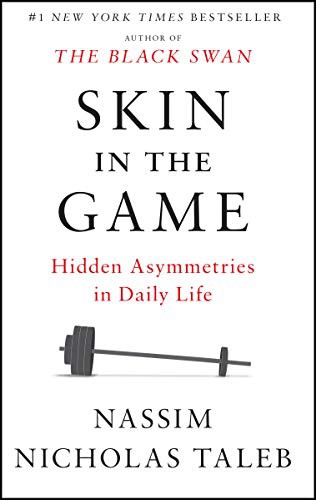
Skin in the Game: Hidden Asymmetries in Daily Life
Nassim Nicholas Taleb
