Talk to The Big Change like its author wrote you back.
Get the ideas that fit your life — not generic summaries.
- Chat with the book
- Audiobook-style main ideas
- Adapts to your life and goals
- Helps you take action
What it argues
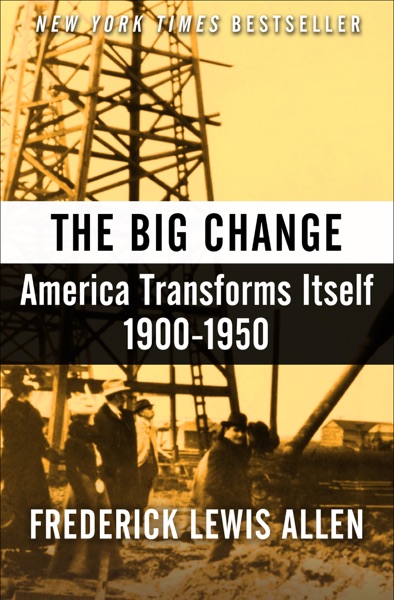
The Big Change is Frederick Lewis Allen's account of how the United States was transformed between 1900 and 1950, covering the shifts in technology, economics, social life, and values that remade American society in half a century. Allen is best known for Only Yesterday, his brilliant popular history of the 1920s, and The Big Change has a similar tone: informal, direct, and free of academic apparatus, written by a journalist who spent his career as editor of Harper's Magazine and believed that the job of the historian was to make history readable.
Allen's central argument is that the most significant change in American life during this period was not any particular event—not World War One, not the Depression, not World War Two—but the broad diffusion of prosperity and material comfort down the income ladder. In 1900, the United States had a small, wealthy upper class, a large and precarious working class, and very little in between. By 1950, something genuinely new had emerged: a mass middle class with cars, refrigerators, telephones, and disposable income. Allen tracks this transformation through wages, purchasing power, housing standards, and the emergence of consumer goods that had been luxuries in 1900 and were necessities by 1950.
What it gets right
- 1.
The most significant change in American life between 1900 and 1950 was the broad diffusion of material prosperity to a mass middle class. This was not inevitable; it required specific political and economic choices.
- 2.
The automobile, electricity, and the telephone changed the daily texture of American life more profoundly than any political event of the period. Technology was the primary driver of social transformation.
- 3.
The robber baron era's concentration of wealth and power provoked the Progressive movement, the antitrust era, and ultimately the New Deal—a self-correcting mechanism in democratic capitalism that Allen sees as characteristic of American history.
What it covers
Who wrote it
Frederick Lewis Allen was an American journalist, historian, and magazine editor who lived from 1890 to 1954. He served as editor-in-chief of Harper's Magazine from 1941 until his death. His first book, Only Yesterday: An Informal History of the 1920s, published in 1931, became an immediate bestseller and is still in print. The Big Change, published in 1952, was his last major work. Allen wrote history as journalism—readable, accessible, and explicitly addressed to non-specialists—and his approach influenced how popular history writing developed in the mid-twentieth century.
