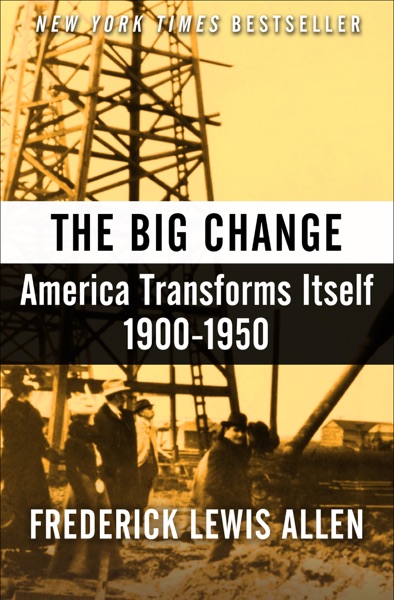
The Big Change by Frederick Lewis Allen is a 1952 history book about american history, social change, economic progress. The most significant change in American life between 1900 and 1950 was the broad diffusion of material prosperity to a mass middle class. This was not inevitable; it required specific political and economic choices.
Summary
The Big Change is Frederick Lewis Allen's account of how the United States was transformed between 1900 and 1950, covering the shifts in technology, economics, social life, and values that remade American society in half a century. Allen is best known for Only Yesterday, his brilliant popular history of the 1920s, and The Big Change has a similar tone: informal, direct, and free of academic apparatus, written by a journalist who spent his career as editor of Harper's Magazine and believed that the job of the historian was to make history readable.
Allen's central argument is that the most significant change in American life during this period was not any particular event—not World War One, not the Depression, not World War Two—but the broad diffusion of prosperity and material comfort down the income ladder. In 1900, the United States had a small, wealthy upper class, a large and precarious working class, and very little in between. By 1950, something genuinely new had emerged: a mass middle class with cars, refrigerators, telephones, and disposable income. Allen tracks this transformation through wages, purchasing power, housing standards, and the emergence of consumer goods that had been luxuries in 1900 and were necessities by 1950.
The book also covers the political economy of the transformation: the rise of unions, the New Deal's restructuring of labor relations and financial regulation, the professionalization of management, and the evolution of corporate capitalism from the robber baron era toward the managerial capitalism of the postwar period. Allen is not a radical; his sympathies are liberal in the older American sense of valuing individual freedom and practical improvement. He tells the story of American capitalism's self-reform without treating it as inevitable or as sufficient.
The Big Change has aged in complicated ways. Its confidence about the permanence of broadly shared prosperity looks different from 2026 than it did from 1952. Its treatment of African American experience is inadequate by any modern standard. But as a portrait of how ordinary American life changed between 1900 and 1950—the texture of daily life, the transformation of work, the emergence of the consumer economy—it remains one of the most readable and informative accounts available.
Talk to The Big Change like its author wrote you back.
Get the ideas that fit your life — not generic summaries.
- Chat with the book
- Audiobook-style main ideas
- Adapts to your life and goals
- Helps you take action
Key takeaways
- 1.
The most significant change in American life between 1900 and 1950 was the broad diffusion of material prosperity to a mass middle class. This was not inevitable; it required specific political and economic choices.
- 2.
The automobile, electricity, and the telephone changed the daily texture of American life more profoundly than any political event of the period. Technology was the primary driver of social transformation.
- 3.
The robber baron era's concentration of wealth and power provoked the Progressive movement, the antitrust era, and ultimately the New Deal—a self-correcting mechanism in democratic capitalism that Allen sees as characteristic of American history.
- 4.
The New Deal did not end the Depression, but it restructured American capitalism in ways that made postwar prosperity more broadly distributed. Collective bargaining, deposit insurance, and securities regulation all date from this period.
- 5.
Corporate management professionalized between 1900 and 1950, evolving from owner-operated businesses into large bureaucracies governed by professional managers with training in business and law.
- 6.
The consumer economy that emerged by 1950 required not just higher wages but consumer credit, marketing, and the cultural legitimation of spending as a social good. All of these were consciously developed.
- 7.
Allen's portrait of 1900 America shows how genuinely poor and insecure most Americans were: no social security, no unemployment insurance, no workplace safety regulations, no consumer protections. The transformation he describes is real and large.
Discussion questions
Use these on your own, with a book club, or as chat starters in Superbook. Book club version, ready to copy or print →
- 1.
Allen argues that American capitalism reformed itself between 1900 and 1950. Is that the right framing, or was it more accurately reformed by outside pressure from labor, politics, and government?
- 2.
The Big Change was written at the high point of American postwar prosperity. Reading it now, does Allen's confidence about the permanence of the broad middle class seem earned or naive?
- 3.
Which of the technological changes Allen describes—car, phone, electricity—had the largest social consequences? Would you assess them the same way he does?
- 4.
Allen largely ignores the experience of Black Americans in this period of transformation. What does that omission cost the account? Is the book still useful despite it?
- 5.
The New Deal appears in the book as a broadly positive restructuring of American capitalism. How would you assess it now, with another 70 years of evidence?
- 6.
Allen describes the professionalization of corporate management as progress. Looking at the subsequent history, was he right?
- 7.
The consumer economy Allen describes as emerging in the 1940s and 1950s is now more entrenched than he imagined. What do you think of the bargain: material prosperity in exchange for what?
- 8.
Allen wrote for a popular audience at Harper's. Does that journalistic style—accessible, informal, sometimes superficial—serve historical writing well, or does it sacrifice important complexity?
- 9.
What parallels do you see between the economic transformation Allen describes and the digital transformation of the past 30 years?
- 10.
Allen's sympathies are with liberal democratic capitalism. Does that sympathy make the book more useful or less useful for understanding the period?
- 11.
What do you think the equivalent of Allen's Big Change will be for the period 1970–2020, if someone writes a similar book in 2050?
Themes
Frequently asked questions
-
What is The Big Change about?
The transformation of American society between 1900 and 1950, focusing on the emergence of a mass middle class, the rise of consumer goods and technology, the restructuring of labor relations, and the evolution of corporate capitalism.
-
Is The Big Change still worth reading?
Yes, with caveats. As a picture of how daily American life changed across the first half of the twentieth century, it's unusually readable and informative. Its treatment of race is a significant gap, and its confidence about the stability of postwar prosperity doesn't survive contact with subsequent history.
-
How does The Big Change compare to Allen's other books?
Only Yesterday is more celebrated because it covers the 1920s with brilliant period detail and comic timing. The Big Change is broader in scope and more analytical. Readers who like Only Yesterday will find the approach familiar.
-
Who should read The Big Change?
Anyone interested in how American society and economy developed in the early twentieth century, or looking for context for understanding the New Deal era, the rise of the consumer economy, or the transformation of corporate capitalism.
-
Is The Big Change politically biased?
Allen is a liberal in the traditional American sense—sympathetic to reform capitalism, unions, and the New Deal, skeptical of both laissez-faire excess and socialism. That perspective shapes what he covers and how he interprets it, but he's not polemical.
Similar books
A People's History of the United States
Howard Zinn
The Warmth of Other Suns
Isabel Wilkerson
American Nations
Colin Woodard
Sapiens: A Brief History of Humankind
Yuval Noah Harari
