Science · Book club
The Big Picture: On the Origins of Life, Meaning, and the Universe Itself book club questions
Here are 12 book club questions for The Big Picture: On the Origins of Life, Meaning, and the Universe Itself by Sean Carroll, ordered to open easily and end somewhere worth arguing about. Copy them, print them, or bring them up one at a time.
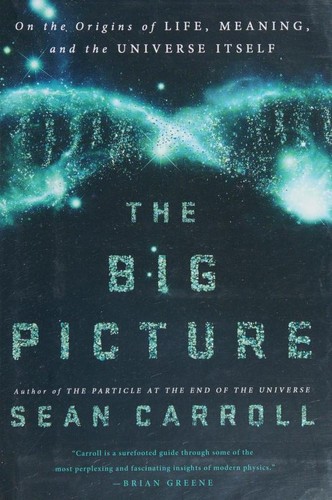
The Big Picture is physicist Sean Carroll's attempt to do something genuinely ambitious: build a coherent worldview from the ground up, starting from the laws of physics and working outward through chemistry, biology, consciousness, and ultimately meaning.
Sean Carroll · 2016 · 7h 45m
Full summary and key takeaways →The 12 questions
- 1.
Carroll argues that the Core Theory leaves no room for undiscovered forces at human-relevant scales. Does that feel like a constraint on explanation, or a clarifying boundary?
- 2.
Poetic naturalism says multiple levels of description are valid simultaneously. Can you think of a case where you switch between levels — say, talking about emotions versus talking about neuroscience — and what you lose or gain in each?
- 3.
Carroll is careful to take religious explanations seriously before rejecting them. Does that approach seem more honest than dismissal, or does it just soften a conclusion that is the same in the end?
- 4.
Bayesian reasoning requires honest prior probabilities. What's one belief you hold where you've never seriously confronted what your prior probability is? What would it take to shift it?
- 5.
The compatibilist view says your choices are still meaningfully yours even if they are physically determined. Does that distinction matter to you emotionally, or only philosophically?
- 6.
Carroll argues that meaning is constructed, not discovered. Does that satisfy you as an account of why anything matters, or does it seem to leave something out?
- 7.
The arrow of time section suggests that if the universe had started in a higher-entropy state, we would remember the future instead of the past. What does that imply about the relationship between memory and causation?
- 8.
Carroll treats consciousness as an emergent physical phenomenon. At what point — if ever — would evidence for something genuinely non-physical be credible to you?
- 9.
The book argues that moral principles can be justified without reference to God or cosmic order. What is the strongest objection to that position?
- 10.
Carroll recommends updating your beliefs using Bayes' theorem. In practice, which of your held beliefs are most resistant to evidence, and why?
- 11.
The final sections argue that we can live well and find value without any external source of meaning. Do you find that conclusion comforting, or does it require something like courage to accept?
- 12.
What is the most surprising claim in the book — the one that most challenged something you thought you understood?
How to run the discussion
- Pick six to eight, not all of them. An hour of real discussion covers fewer questions than anyone expects, and racing the list is what makes a book club feel like homework.
- Open with what people noticed, not what they concluded. Asking for a verdict first hardens opinions before anyone has heard each other.
- Let the disagreement run. The questions below that split a room are the ones worth the time; the ones everyone answers the same way can be skipped.
- Ask the quiet person a specific question. A direct, narrow question is far easier to answer than an open invitation to contribute.
Themes worth steering toward
If the conversation stalls, these are the threads that usually restart it.
Common questions
What are good book club questions for The Big Picture: On the Origins of Life, Meaning, and the Universe Itself?
Here are 12 book club questions for The Big Picture: On the Origins of Life, Meaning, and the Universe Itself by Sean Carroll, ordered to open easily and end somewhere worth arguing about. The strongest openers ask what each reader noticed rather than what they concluded, and the discussion usually turns on cosmology, philosophy of science, emergence.
How long should a book club discussion of The Big Picture: On the Origins of Life, Meaning, and the Universe Itself last?
Most groups run 60 to 90 minutes of actual discussion. That is roughly six to eight questions, not all of them, so pick the ones that suit your group rather than working down the list in order.
What are the main themes in The Big Picture: On the Origins of Life, Meaning, and the Universe Itself?
Cosmology, Philosophy of science, Emergence, Meaning, Naturalism. Those are the threads most likely to divide a room, which makes them the useful places to steer a discussion that has gone quiet.
Picking the next one? See books like The Big Picture: On the Origins of Life, Meaning, and the Universe Itself or questions for other book club picks.
