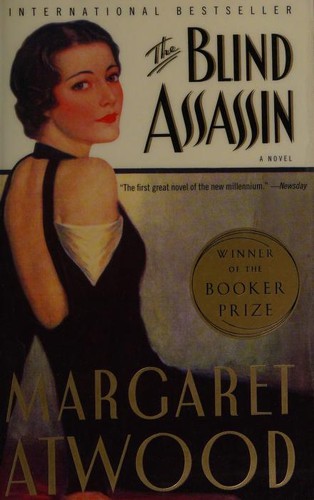
Talk to The Blind Assassin like its author wrote you back.
Get the ideas that fit your life — not generic summaries.
- Chat with the book
- Audiobook-style main ideas
- Adapts to your life and goals
- Helps you take action
The Blind Assassin, in detail
The Blind Assassin won the Man Booker Prize in 2000 and is arguably Atwood's most formally intricate novel. It opens with the announcement that Iris Chase's sister Laura died driving off a bridge shortly after the end of World War Two, and the question of whether that death was an accident or suicide hangs over everything that follows. The main narrative is Iris's memoir, written in her eighties in a small Ontario town where she is slowly dying, but the novel contains two other embedded narratives: a pulp science fiction story told by unnamed lovers in secret meetings, and newspaper clippings, society column entries, and other fragments from the period.
The science fiction story — in which a blind assassin on an alien world falls in love with a sacrificed mute girl — is the novel's most unexpected element. It appears as a posthumously published novel attributed to Laura Chase, and it becomes clear as the novel progresses that the story is actually about the secret affair between Iris and her lover, Alex Thomas, a left-wing activist her wealthy family disapproves of. The layers of narrative folding back on themselves — who wrote what, who knew what, who survived and who didn't — is what the novel is building toward, and the final revelation reshapes everything you've read.
Atwood is interested in how stories are used as containers for what cannot be said directly. The pulp fiction within the novel functions as an escape valve: the lovers can only discuss their real situation in the language of a made-up world. The novel as a whole asks whether Iris's memoir — ostensibly a confession — is actually an act of posthumous revenge, the final settling of a score with a dead husband and a dead society. Whether it's redemptive or merely vindictive is a question Atwood leaves open.
This is a long and layered novel that requires patience with multiple narrative timelines and a large cast. The science fiction sections, in particular, operate in a completely different register from the rest of the book — pulpy and allegorical rather than precise and historicized. The payoff is substantial, but the first hundred pages ask you to trust that the pieces will cohere. For readers who want a more immediately legible Atwood, The Handmaid's Tale or Alias Grace is a better starting point. But for readers prepared to commit to the structure, The Blind Assassin is a more ambitious and ultimately more devastating work than either.
The big ideas
- 1.
The novel's central structural revelation — who actually wrote the pulp novel attributed to Laura — reframes every scene involving the sisters and changes what you understand about Iris's entire life.
- 2.
Atwood uses genre fiction as a formal device: the pulp science fiction sections operate as a space where the lovers can speak truth they cannot speak anywhere else, which is what genre fiction has always been for.
- 3.
Iris's memoir is not straightforwardly reliable — she withholds information, misdirects the reader, and constructs herself as somewhat more innocent than she is. The reader's job is to notice what she doesn't say.
