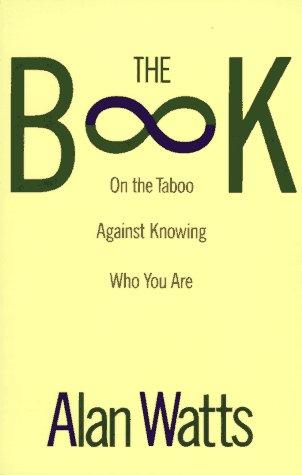
Talk to The Book: On the Taboo Against Knowing Who You Are like its author wrote you back.
Get the ideas that fit your life — not generic summaries.
- Chat with the book
- Audiobook-style main ideas
- Adapts to your life and goals
- Helps you take action
What it argues
The Book, published in 1966, is Alan Watts's most direct attempt to explain the central illusion he spent his career examining: the belief that each of us is a separate self, enclosed in skin, confronting an alien world. Watts calls this illusion the "skin-encapsulated ego" and argues that it is not a natural perception but a cultural instruction — something we are taught, usually by well-meaning adults, that becomes so habitual we mistake it for reality.
The argument is grounded in Vedanta, the Hindu philosophical tradition, which holds that the individual self and the universe are not separate in the way they appear to be. Watts translates this for Western readers without either dumbing it down or turning it into mysticism. His version of the claim is almost physicalist: the organism and its environment are a single system. The boundary at the skin is real in one sense and misleading in another. What we call the self is a pattern in a larger process, not a fixed entity moving through a fixed world.
What it gets right
- 1.
The sense of being a separate self enclosed in skin is not a natural perception — it is a cultural instruction, habituated until it feels like obvious fact.
- 2.
The organism and its environment are a single system. The boundary at the skin is real as a membrane but misleading as a definition of what you are.
- 3.
What Vedanta calls the Atman — the individual self — and Brahman — the universal ground — are not two things. This is the insight Western culture has most systematically refused.
What it covers
Who wrote it
Alan Watts (1915–1973) was a British-born philosopher, writer, and speaker who spent the second half of his career in California interpreting Asian philosophical and religious traditions for Western audiences. He studied theology at Seabury-Western Theological Seminary and was briefly ordained as an Episcopalian priest before leaving institutional religion. His more than 25 books include The Way of Zen, Psychotherapy East and West, and The Wisdom of Insecurity. He became a major influence on the American counterculture of the 1960s and remains widely read and listened to through recordings of his lectures.
