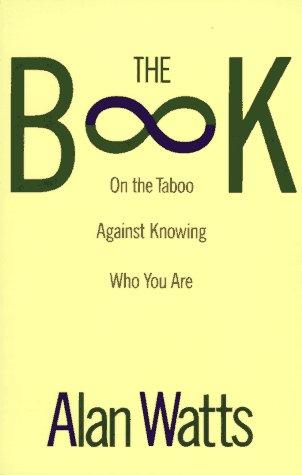
Talk to The Book: On the Taboo Against Knowing Who You Are like its author wrote you back.
Get the ideas that fit your life — not generic summaries.
- Chat with the book
- Audiobook-style main ideas
- Adapts to your life and goals
- Helps you take action
The Book: On the Taboo Against Knowing Who You Are, in detail
The Book, published in 1966, is Alan Watts's most direct attempt to explain the central illusion he spent his career examining: the belief that each of us is a separate self, enclosed in skin, confronting an alien world. Watts calls this illusion the "skin-encapsulated ego" and argues that it is not a natural perception but a cultural instruction — something we are taught, usually by well-meaning adults, that becomes so habitual we mistake it for reality.
The argument is grounded in Vedanta, the Hindu philosophical tradition, which holds that the individual self and the universe are not separate in the way they appear to be. Watts translates this for Western readers without either dumbing it down or turning it into mysticism. His version of the claim is almost physicalist: the organism and its environment are a single system. The boundary at the skin is real in one sense and misleading in another. What we call the self is a pattern in a larger process, not a fixed entity moving through a fixed world.
The cultural consequences Watts traces are wide. The belief in a separate, vulnerable self generates chronic anxiety. The need to dominate and control nature is a product of feeling separate from it. The violence people do to others and to the environment is, on this account, a kind of self-violence carried out in ignorance of the larger pattern. Watts is not preachy about this, but he is explicit.
What Watts offers in place of the separate-self model is not a prescription but a shift in perception. He is not asking readers to believe something different so much as to notice something they are already doing. The book works best on readers who have already felt, at least momentarily, that the boundary between self and world is less solid than usually assumed. For readers who haven't, it can feel like an abstract argument that resists landing.
The big ideas
- 1.
The sense of being a separate self enclosed in skin is not a natural perception — it is a cultural instruction, habituated until it feels like obvious fact.
- 2.
The organism and its environment are a single system. The boundary at the skin is real as a membrane but misleading as a definition of what you are.
- 3.
What Vedanta calls the Atman — the individual self — and Brahman — the universal ground — are not two things. This is the insight Western culture has most systematically refused.
