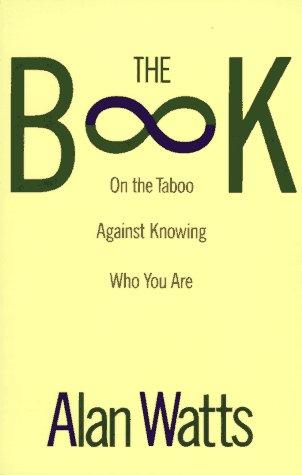
The Book: On the Taboo Against Knowing Who You Are by Alan Watts is a 1966 philosophy book about identity, consciousness, interconnection. The sense of being a separate self enclosed in skin is not a natural perception — it is a cultural instruction, habituated until it feels like obvious fact.
Summary
The Book, published in 1966, is Alan Watts's most direct attempt to explain the central illusion he spent his career examining: the belief that each of us is a separate self, enclosed in skin, confronting an alien world. Watts calls this illusion the "skin-encapsulated ego" and argues that it is not a natural perception but a cultural instruction — something we are taught, usually by well-meaning adults, that becomes so habitual we mistake it for reality.
The argument is grounded in Vedanta, the Hindu philosophical tradition, which holds that the individual self and the universe are not separate in the way they appear to be. Watts translates this for Western readers without either dumbing it down or turning it into mysticism. His version of the claim is almost physicalist: the organism and its environment are a single system. The boundary at the skin is real in one sense and misleading in another. What we call the self is a pattern in a larger process, not a fixed entity moving through a fixed world.
The cultural consequences Watts traces are wide. The belief in a separate, vulnerable self generates chronic anxiety. The need to dominate and control nature is a product of feeling separate from it. The violence people do to others and to the environment is, on this account, a kind of self-violence carried out in ignorance of the larger pattern. Watts is not preachy about this, but he is explicit.
What Watts offers in place of the separate-self model is not a prescription but a shift in perception. He is not asking readers to believe something different so much as to notice something they are already doing. The book works best on readers who have already felt, at least momentarily, that the boundary between self and world is less solid than usually assumed. For readers who haven't, it can feel like an abstract argument that resists landing.
Talk to The Book: On the Taboo Against Knowing Who You Are like its author wrote you back.
Get the ideas that fit your life — not generic summaries.
- Chat with the book
- Audiobook-style main ideas
- Adapts to your life and goals
- Helps you take action
Key takeaways
- 1.
The sense of being a separate self enclosed in skin is not a natural perception — it is a cultural instruction, habituated until it feels like obvious fact.
- 2.
The organism and its environment are a single system. The boundary at the skin is real as a membrane but misleading as a definition of what you are.
- 3.
What Vedanta calls the Atman — the individual self — and Brahman — the universal ground — are not two things. This is the insight Western culture has most systematically refused.
- 4.
Chronic anxiety is partly a product of identifying with a small, separate self that must be protected against an indifferent universe. The indifference changes when the separation is questioned.
- 5.
The human domination of nature follows logically from the premise of separateness. If you are the organism and the environment is other, exploitation is rational. If you are the system, it isn't.
- 6.
Children are taught the separate-self model before they have the cognitive capacity to examine it. By the time they can, it feels like common sense rather than an assumption.
- 7.
The game metaphor: life as a game requires players who temporarily forget they are playing. The forgetting is the game. Waking up does not end the game — it changes how it is played.
- 8.
Eastern traditions that point to non-separation are not asking for belief. They are pointing at a recognizable experience most people have had briefly and then rationalized away.
Discussion questions
Use these on your own, with a book club, or as chat starters in Superbook. Book club version, ready to copy or print →
- 1.
Watts argues that the sense of being a separate, enclosed self is taught rather than perceived. Does that claim seem right to you? What is your evidence either way?
- 2.
Have you ever had an experience — in nature, in meditation, in a moment of intense absorption — where the boundary between self and surroundings felt less solid? What did you make of it at the time?
- 3.
The book was written in 1966, during significant cultural upheaval. How much of its argument is universal and how much is it a product of its moment?
- 4.
Watts links the belief in a separate self to the exploitation of nature. Is that causal claim convincing, or does it feel like too large a leap?
- 5.
He draws heavily on Vedanta. For readers without that background, does the Hindu framework help the argument or create distance from it?
- 6.
Watts says he is pointing at something most readers have already experienced. What experience in your own life comes closest to what he seems to be describing?
- 7.
The book argues that knowing who you really are would be liberating, not frightening. Does it feel that way to you, or does the dissolution of the separate self feel like a loss?
- 8.
What is the 'taboo' in Watts's title? Why does he think this knowledge is suppressed?
- 9.
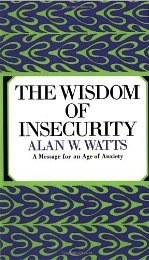
How does The Book compare to The Wisdom of Insecurity for readers who've read both? Does the later book add something the earlier one didn't?
- 10.
Watts is a popularizer working with difficult philosophical material. Does that make him trustworthy or does it make you want to go to the source texts?
- 11.
The game metaphor — life as a game that requires forgetting it's a game — is the book's most memorable idea. Does it help or frustrate you?
- 12.
If Watts's argument were true, what would change about how you make decisions, relate to others, or think about your own death?
Themes
Frequently asked questions
-
What is The Book by Alan Watts actually about?
It argues that the Western sense of being a separate self, enclosed in skin and facing an alien world, is a cultural construction rather than a natural perception. Drawing on Vedanta, Watts makes the case that the individual and the universe are aspects of a single system — and that recognizing this changes the quality of experience and behavior.
-
Is The Book on the Taboo Against Knowing Who You Are worth reading?
Yes, particularly for readers willing to engage with a philosophical argument that resists being summarized as advice. It is one of Watts's clearest and most focused books. Readers who want techniques or exercises will find it unsatisfying; readers willing to sit with ideas will find it returns to them over years.
-
How does this book relate to Eastern philosophy?
It is primarily grounded in Vedanta, the Hindu philosophical tradition. Watts also draws on Zen, Taoism, and some Western philosophy. He is not a scholar of these traditions in an academic sense, but rather an interpreter who uses them to make a coherent argument for non-Western ideas about the self.
-
Who should read The Book?
Readers who have found conventional Western frameworks for identity — the individual as autonomous agent — unsatisfying or incomplete. Also readers who are curious about what Eastern philosophy actually claims, rather than the diluted versions in popular mindfulness culture. It rewards more than one reading.
-
How long does it take to read?
Around three to four hours, though the book is short enough to read in one sitting. Dense passages benefit from slow reading. Many readers find the final chapter — on cosmic identity — requires re-reading before it lands.