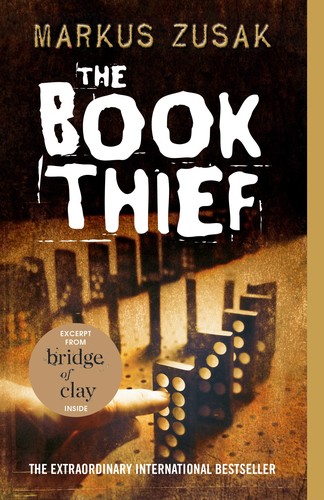
Talk to The Book Thief like its author wrote you back.
Get the ideas that fit your life — not generic summaries.
- Chat with the book
- Audiobook-style main ideas
- Adapts to your life and goals
- Helps you take action
What it argues
The Book Thief is set in a small German town during World War II and narrated by Death. Liesel Meminger, nine years old, arrives at a foster home on Himmel Street after her brother dies en route. She cannot read, but she is drawn obsessively to books — stealing her first from a grave, working through others pilfered from bonfires and a mayor's library. Her foster father Hans Hubermann teaches her to read in the basement at night. The household later shelters a Jewish fist-fighter named Max Vandenburg in that same basement, and his presence binds the novel's threads together.
The novel is fundamentally about what language does in the face of violence. Hitler's regime is explicitly a project of words — of propaganda, book-burning, and the replacement of ordinary speech with ideology. Zusak positions Liesel's theft of books as a counter-gesture: to possess words is to hold something the regime cannot fully control. Max writes stories for Liesel on painted-over pages of Mein Kampf. Words are everywhere a double agent — they build and destroy, they save people and betray them. The novel takes that theme seriously without becoming schematic.
What it gets right
- 1.
The novel argues that stories and words are the only things that survive history — and the only things history can truly destroy. Both are true simultaneously.
- 2.
Hans Hubermann's quiet decency — teaching Liesel to read, sheltering Max, giving bread to a Jewish prisoner — is the novel's moral center, not the more dramatic gestures.
- 3.
Death as narrator creates a structural irony: we know more than the characters do, which turns dread into a sustained state rather than a plot device.
What it covers
Who wrote it
Markus Zusak is an Australian novelist born in Sydney in 1975 to German and Austrian immigrant parents, which grounded his knowledge of wartime Germany. He published four young adult novels before The Book Thief, which became an international phenomenon after its 2005 publication in Australia and 2006 release in the United States. It spent more than a decade on the New York Times bestseller list. His 2018 follow-up, Bridge of Clay, was another multigenerational family narrative. Zusak is known for maximalist prose and structural experimentation within accessible storytelling.
