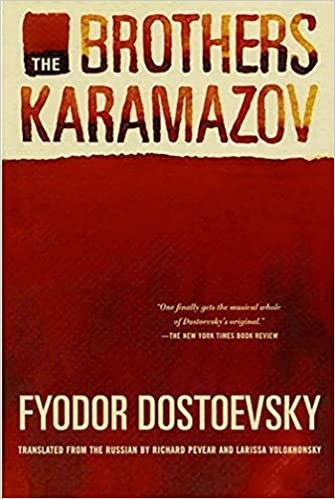
Talk to The Brothers Karamazov like its author wrote you back.
Get the ideas that fit your life — not generic summaries.
- Chat with the book
- Audiobook-style main ideas
- Adapts to your life and goals
- Helps you take action
What it argues
Three brothers — Dmitri, Ivan, and Alyosha Karamazov — orbit around their contemptible, sensuous father Fyodor, who is also a rival with Dmitri for the affections of a local woman. When Fyodor is murdered, each brother is implicated in a different way: Dmitri had motive and was seen near the house; Ivan's philosophical ideas, stripped of God and therefore of moral law, arguably made the act thinkable; Alyosha, the youngest and most saintly, failed to prevent it. The murder mystery is real, but it is a frame for questions that go much deeper.
The Brothers Karamazov is the most explicitly philosophical major novel in the Western canon. Ivan's rebellion against God — his argument that the suffering of innocent children makes any divine plan morally inadmissible — is one of the most serious challenges to theodicy in literature, and it arrives not in an essay but in a conversation between brothers that Dostoevsky renders with complete fairness to both sides. The Grand Inquisitor chapter, in which Ivan reads a prose poem about Christ returning to fifteenth-century Seville only to be arrested by the Church, is one of the most discussed passages in modern literature. Dostoevsky the believer built the strongest case he could against his own beliefs, and then attempted to answer it through Alyosha and the elder Zosima.
What it gets right
- 1.
Ivan's rebellion — refusing to accept any God who permits the suffering of innocent children — is Dostoevsky's most honest engagement with atheism, built to be as strong as he could make it.
- 2.
The Grand Inquisitor chapter argues that human beings want bread and authority more than freedom, and that the Church understands this better than Christ did. Dostoevsky spent the rest of the novel trying to answer it.
- 3.
Alyosha is Dostoevsky's counter to Ivan: not an intellectual but a loving presence whose faith is embodied rather than argued.
What it covers
Who wrote it
Fyodor Dostoevsky (1821–1881) was a Russian novelist, journalist, and philosopher whose work explored psychology, religion, political ideology, and the suffering of the poor. He was arrested in 1849 for involvement with a radical literary circle and came within minutes of execution before his sentence was commuted to Siberian imprisonment. The Brothers Karamazov, published the year before his death, is widely considered his masterpiece and among the greatest novels ever written. His other major works include Crime and Punishment, The Idiot, and Demons. He was a foundational influence on existentialism, modern psychology, and twentieth-century fiction.
