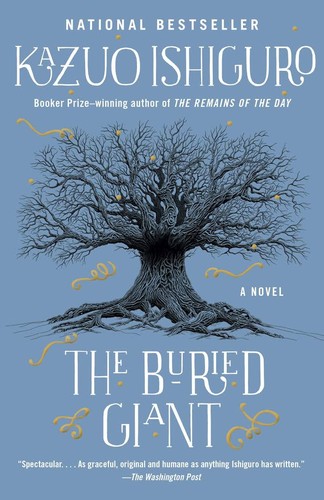
Talk to The Buried Giant like its author wrote you back.
Get the ideas that fit your life — not generic summaries.
- Chat with the book
- Audiobook-style main ideas
- Adapts to your life and goals
- Helps you take action
What it argues
An elderly British couple, Axl and Beatrice, set out to visit their son in a post-Arthurian England where a strange mist has settled over the land, robbing everyone of their memories. They cannot remember their son's village clearly. They cannot remember much of their own past. As they travel, they encounter a warrior, an orphan boy, and a monk — and slowly realize that the memory loss is not random but has a source, and that the source is connected to King Arthur and a buried violence no one has been allowed to remember.
The book is Ishiguro doing something he has done before in The Remains of the Day: examining what it costs to forget, and what it costs to remember. Here the question is scaled up from individual psychology to communal history. The mist that erases memory has kept Saxons and Britons from killing each other after Arthur's wars; when it lifts, the violence will return. Is the forgetting a mercy or a crime? Ishiguro refuses an easy answer. The couple at the center are also in their own version of this question — there is something in their marriage they have not let themselves remember, and its recovery will change what they are to each other.
What it gets right
- 1.
The 'buried giant' of the title is both the repressed violence of Arthur's wars and the personal history that Axl and Beatrice have not allowed themselves to recover.
- 2.
Ishiguro uses fantasy elements not as genre but as allegory: the memory-erasing mist is a literal image for how communities suppress traumatic collective memory to preserve fragile peace.
- 3.
The novel's central question — is forgetting sometimes a mercy? — has clear real-world implications for post-conflict societies and for truth-and-reconciliation processes.
What it covers
Who wrote it
Kazuo Ishiguro was born in Nagasaki, Japan, in 1954 and moved to England at the age of five. He is the author of eight novels, including A Pale View of Hills (1982), The Remains of the Day (1989), Never Let Me Go (2005), The Buried Giant (2015), and Klara and the Sun (2021). The Remains of the Day won the Booker Prize, and in 2017 Ishiguro was awarded the Nobel Prize in Literature. He is known for his restrained prose, his unreliable narrators, and his sustained interest in the relationship between memory, repression, and self-deception.
