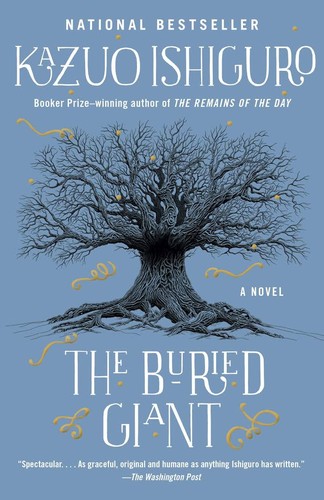
The Buried Giant by Kazuo Ishiguro is a 2015 literary fiction book about memory and forgetting, grief and marriage, war and reconciliation. The 'buried giant' of the title is both the repressed violence of Arthur's wars and the personal history that Axl and Beatrice have not allowed themselves to recover.
Summary
An elderly British couple, Axl and Beatrice, set out to visit their son in a post-Arthurian England where a strange mist has settled over the land, robbing everyone of their memories. They cannot remember their son's village clearly. They cannot remember much of their own past. As they travel, they encounter a warrior, an orphan boy, and a monk — and slowly realize that the memory loss is not random but has a source, and that the source is connected to King Arthur and a buried violence no one has been allowed to remember.
The book is Ishiguro doing something he has done before in The Remains of the Day: examining what it costs to forget, and what it costs to remember. Here the question is scaled up from individual psychology to communal history. The mist that erases memory has kept Saxons and Britons from killing each other after Arthur's wars; when it lifts, the violence will return. Is the forgetting a mercy or a crime? Ishiguro refuses an easy answer. The couple at the center are also in their own version of this question — there is something in their marriage they have not let themselves remember, and its recovery will change what they are to each other.
The novel is written in a gentle, slightly archaic prose that fits its Arthurian setting without becoming parody. Ishiguro is not interested in fantasy for its own sake; the mythological elements function as allegorical scaffolding for questions about guilt, reconciliation, and the politics of collective amnesia. The pace is deliberately slow — this is a quest novel in which most of the quest is conversation and interior reflection.
Readers who loved The Remains of the Day or Never Let Me Go will recognize the Ishiguro approach: a quiet surface concealing devastating implications, an ending that arrives with almost no announcement. Readers who came for dragons and Arthurian adventure will find the novel far less interested in genre than its premise suggests. It is a quiet, strange, genuinely unsettling book.
Talk to The Buried Giant like its author wrote you back.
Get the ideas that fit your life — not generic summaries.
- Chat with the book
- Audiobook-style main ideas
- Adapts to your life and goals
- Helps you take action
Key takeaways
- 1.
The 'buried giant' of the title is both the repressed violence of Arthur's wars and the personal history that Axl and Beatrice have not allowed themselves to recover.
- 2.
Ishiguro uses fantasy elements not as genre but as allegory: the memory-erasing mist is a literal image for how communities suppress traumatic collective memory to preserve fragile peace.
- 3.
The novel's central question — is forgetting sometimes a mercy? — has clear real-world implications for post-conflict societies and for truth-and-reconciliation processes.
- 4.
Axl and Beatrice's marriage is the book's emotional core: the mist has stolen their memories of each other, and the novel is partly about what a long marriage looks like when you must rediscover rather than remember it.
- 5.
The Arthurian setting allows Ishiguro to work with Britain's mythological self-image — a kingdom that achieved peace through Arthur — and to ask what that peace was built on and what it cost.
- 6.
The slow pace is deliberate: the novel is structured as a journey inward rather than a journey across, and its rewards are accumulative.
- 7.
Ishiguro extends his career-long interest in the unreliable interior monologue to an unreliable shared exterior world — the mist is a collective narrator who may not be telling the whole truth.
- 8.
The ending returns to a passage from the novel's opening pages and inverts its meaning, which is a characteristically quiet Ishiguro devastation.
Discussion questions
Use these on your own, with a book club, or as chat starters in Superbook. Book club version, ready to copy or print →
- 1.
The mist has prevented another war between Saxons and Britons by erasing memories of past atrocities. Is that a justifiable trade-off? Who gets to decide?
- 2.
Axl and Beatrice's relationship changes as they recover memories. Does the novel suggest that remembering is always better than forgetting for a couple, or is it more ambivalent?
- 3.
Sir Gawain is depicted as an old knight still bound by loyalty to Arthur. Is he a figure of honor or a figure of delusion in this novel?
- 4.
How does The Buried Giant compare to The Remains of the Day in its treatment of suppression and memory? Which novel do you find more emotionally devastating?
- 5.
The orphan Edwig and the warrior Wistan represent a coming reckoning. Do you think Ishiguro wants you to root for the violence that will follow the mist's lifting?
- 6.
The novel was criticized by some fantasy readers for not being fantasy enough and by some literary fiction readers for using fantasy at all. Where did you land on that debate?
- 7.
The prose is deliberately gentle and somewhat archaic. Did that register work for you, or did it create distance from the emotional content?
- 8.
Ishiguro has said the novel is partly about the tensions that can underlie long marriages. What is Axl and Beatrice keeping from each other, and does the novel judge them for it?
- 9.
The ending is ambiguous in one specific way. How did you read the final scene, and does the ambiguity feel earned or evasive?
- 10.
What contemporary real-world situations does the novel's central allegory about collective forgetting bring to mind?
- 11.
The dragons in this novel are functional rather than spectacular. Is that choice successful? What would change if they were more heroic or more monstrous?
- 12.
Is this a novel about a couple, a novel about a country, or both — and does one reading come at the expense of the other?
Themes
Frequently asked questions
-
Is The Buried Giant worth reading?
Yes, if you're an Ishiguro reader who enjoyed his quieter, more internal work. It is an unusual book — part Arthurian quest, part marital study, part political allegory — and it rewards patience. It is not his most immediately accessible novel, but its implications accumulate.
-
Is this a fantasy novel?
It has fantasy elements — Arthurian setting, a she-dragon, a warrior's quest — but Ishiguro uses them as allegory rather than as genre. Readers expecting fantasy in the George R.R. Martin or Tolkien sense will be surprised and probably disappointed. Readers expecting Ishiguro's characteristic literary sensibility will find exactly that, set in an unusual frame.
-
Is The Buried Giant connected to his other books?
Thematically yes — Ishiguro's entire body of work concerns memory, repression, and the things people allow themselves not to know. The Buried Giant is most closely linked to The Remains of the Day in that both turn on a couple who have suppressed something important and who must decide whether to bring it to light.
-
Who shouldn't read this book?
Readers who want plot-driven narrative momentum will find the pace frustrating. The novel spends a long time traveling a short physical distance, and most of its action is interior. If you need events to happen, look elsewhere.
-
What is the buried giant of the title?
The title has multiple referents: the she-dragon whose breath causes the memory mist, the repressed history of Arthur's wars against the Saxons, and the buried grief and unresolved conflict within Axl and Beatrice's marriage. Ishiguro wants all three meanings to be present simultaneously.