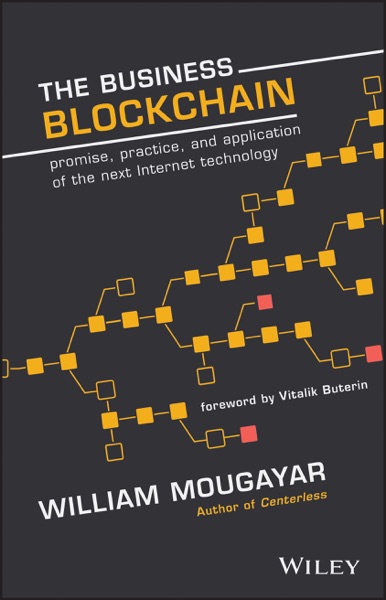
Talk to The Business Blockchain like its author wrote you back.
Get the ideas that fit your life — not generic summaries.
- Chat with the book
- Audiobook-style main ideas
- Adapts to your life and goals
- Helps you take action
The Business Blockchain, in detail
William Mougayar's book was one of the first serious attempts to explain blockchain technology to a business audience rather than a technical one. Published in 2016, before the ICO boom and subsequent crash, it occupies an interesting position in the literature: more sober than the hype cycles that followed, and more strategically minded than the technical white papers that preceded it.
Mougayar's core argument is that blockchain is not primarily a financial technology — it is a trust technology. Traditional business relies on intermediaries (banks, lawyers, clearinghouses, registries) to establish trust between parties. Blockchain, he argues, can perform this function programmatically, removing the intermediary and the cost and friction it introduces. This insight is applied to supply chains, contracts, identity verification, financial settlement, and governance, all of which require parties to trust records they didn't create.
The book is organized around three lenses: technology, business, and economics. The technology sections explain what a blockchain actually is — a distributed ledger maintained by consensus across many nodes — without requiring the reader to understand cryptography. The business sections explore which industries and use cases are most threatened or enabled. The economics section is the most speculative and has aged unevenly; some of Mougayar's predictions about token economics and programmable money have come partly true, others have not.
Reading it a decade later, the book is most useful as a framework document rather than a current-state guide. Mougayar is better at describing the structural logic of blockchain disruption than at predicting specific outcomes. Some of his candidate applications — cross-border payments, land registries, medical records — have progressed slowly for regulatory and adoption reasons he did not fully anticipate. Others, particularly decentralized finance, have moved faster and in directions he only gestured toward. For readers approaching blockchain for the first time, the conceptual foundation holds up reasonably well. For specialists, the book is historical context for how the business case was first articulated.
The big ideas
- 1.
Blockchain is primarily a trust technology: it replaces the need for intermediaries to verify transactions and records between parties who don't trust each other.
- 2.
The three layers of blockchain value are technology infrastructure, business applications, and economic tokens — and they must be evaluated separately.
- 3.
Smart contracts are self-executing agreements: code that runs automatically when conditions are met, removing the need for manual verification or enforcement.
