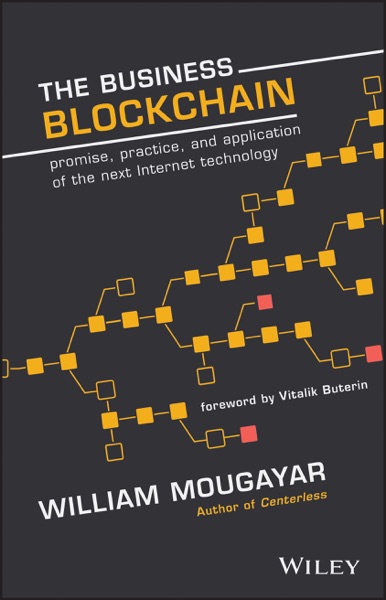
The Business Blockchain by William Mougayar is a 2016 business book about blockchain, decentralization, cryptocurrency. Blockchain is primarily a trust technology: it replaces the need for intermediaries to verify transactions and records between parties who don't trust each other.
Summary
William Mougayar's book was one of the first serious attempts to explain blockchain technology to a business audience rather than a technical one. Published in 2016, before the ICO boom and subsequent crash, it occupies an interesting position in the literature: more sober than the hype cycles that followed, and more strategically minded than the technical white papers that preceded it.
Mougayar's core argument is that blockchain is not primarily a financial technology — it is a trust technology. Traditional business relies on intermediaries (banks, lawyers, clearinghouses, registries) to establish trust between parties. Blockchain, he argues, can perform this function programmatically, removing the intermediary and the cost and friction it introduces. This insight is applied to supply chains, contracts, identity verification, financial settlement, and governance, all of which require parties to trust records they didn't create.
The book is organized around three lenses: technology, business, and economics. The technology sections explain what a blockchain actually is — a distributed ledger maintained by consensus across many nodes — without requiring the reader to understand cryptography. The business sections explore which industries and use cases are most threatened or enabled. The economics section is the most speculative and has aged unevenly; some of Mougayar's predictions about token economics and programmable money have come partly true, others have not.
Reading it a decade later, the book is most useful as a framework document rather than a current-state guide. Mougayar is better at describing the structural logic of blockchain disruption than at predicting specific outcomes. Some of his candidate applications — cross-border payments, land registries, medical records — have progressed slowly for regulatory and adoption reasons he did not fully anticipate. Others, particularly decentralized finance, have moved faster and in directions he only gestured toward. For readers approaching blockchain for the first time, the conceptual foundation holds up reasonably well. For specialists, the book is historical context for how the business case was first articulated.
Talk to The Business Blockchain like its author wrote you back.
Get the ideas that fit your life — not generic summaries.
- Chat with the book
- Audiobook-style main ideas
- Adapts to your life and goals
- Helps you take action
Key takeaways
- 1.
Blockchain is primarily a trust technology: it replaces the need for intermediaries to verify transactions and records between parties who don't trust each other.
- 2.
The three layers of blockchain value are technology infrastructure, business applications, and economic tokens — and they must be evaluated separately.
- 3.
Smart contracts are self-executing agreements: code that runs automatically when conditions are met, removing the need for manual verification or enforcement.
- 4.
Industries most disrupted by blockchain are those that rely on trusted intermediaries — banking, insurance, healthcare records, real estate, and supply chain verification.
- 5.
Decentralization has a cost: distributed consensus is slower and more complex than centralized databases. Blockchain is not superior for every use case.
- 6.
Programmable money and token economies represent a new model for aligning incentives within networks, though the economic design challenges are substantial.
- 7.
The governance challenge is often harder than the technical challenge: who controls the rules of a blockchain, and how are they changed, determines its actual trustworthiness.
Discussion questions
Use these on your own, with a book club, or as chat starters in Superbook. Book club version, ready to copy or print →
- 1.
Mougayar describes blockchain as a trust technology. What other technologies in history have fundamentally changed how trust is established between strangers?
- 2.
Which industries or institutions in your experience are most burdened by the cost of intermediaries, and would blockchain actually help?
- 3.
The book argues that blockchain removes middlemen. What happens to the people whose jobs those are, and is that a straightforward win?
- 4.
Smart contracts execute automatically when conditions are met. What kinds of agreements would benefit from that rigidity, and which would be made worse by it?
- 5.
Mougayar wrote in 2016. Which of his predictions have come true, which have failed, and what does the gap tell you about technology forecasting?
- 6.
Decentralization is presented as an obvious good. What are the legitimate arguments against it, especially for critical infrastructure?
- 7.
Token economics tries to align participant incentives through financial stakes. Where have you seen this model work, and where has it been gamed or failed?
- 8.
The book focuses on business applications of blockchain. Does it adequately address the environmental and energy costs of proof-of-work consensus?
- 9.
Land registries and medical records are offered as compelling use cases. What would it actually take to migrate a national land registry to a blockchain?
- 10.
Governance is the hardest unsolved problem in blockchain. Who do you think should control the rules of a public blockchain, and how?
- 11.
How much of blockchain's appeal, in 2016 and now, is about genuine efficiency gains versus a libertarian preference for systems without institutional gatekeepers?
Themes
Frequently asked questions
-
Is The Business Blockchain still worth reading?
As a conceptual introduction to how blockchain creates value, yes — the framework is clear and the logic holds. As a current-state guide to the industry, it is dated. Read it alongside more recent material on DeFi and enterprise blockchain adoption.
-
Do I need a technical background to read this book?
No. Mougayar explicitly writes for a business audience and explains the technical concepts in plain language. No cryptography or computer science background is required.
-
What is the book's central argument?
That blockchain is a trust technology that removes the need for intermediaries, and that this capability will disrupt any industry where trusted third parties currently add cost and friction without adding proportionate value.
-
How long does it take to read?
Around three to four hours for the 208-page book. The chapters are short and organized so you can read by topic area rather than sequentially.
-
Who should read this book?
Business strategists, startup founders, and executives who want to understand blockchain's structural logic without becoming technologists. Also useful for investors trying to evaluate which blockchain applications have defensible business models.
Similar books
Zero to One: Notes on Startups, or How to Build the Future
Peter Thiel
The Innovator's Dilemma
Clayton M. Christensen
Platform Revolution
Geoffrey G. Parker, Marshall W. Van Alstyne, and Sangeet Paul Choudary
The Lean Startup
Eric Ries
