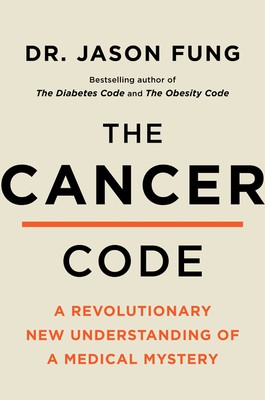
Talk to The Cancer Code like its author wrote you back.
Get the ideas that fit your life — not generic summaries.
- Chat with the book
- Audiobook-style main ideas
- Adapts to your life and goals
- Helps you take action
What it argues
The Cancer Code is Jason Fung's case that oncology's dominant paradigm — cancer as a genetic disease driven by somatic mutations — is incomplete and has contributed to fifty years of largely stagnant survival rates for most cancers. Fung, a Toronto nephrologist known for his work on insulin resistance and fasting, argues that viewing cancer primarily as a metabolic disease rather than a genetic one opens treatment approaches that mainstream oncology has systematically underexplored.
Fung traces the history of cancer research in three paradigms. The first, from Virchow in the nineteenth century, saw cancer as a proliferation disease. The second, which dominated the late twentieth century, identified cancer as primarily a genetic disease caused by mutations in oncogenes and tumor suppressor genes. The third, which Fung advocates, integrates the genetic view with metabolic theory: cancer cells typically rely on aerobic glycolysis (the Warburg effect) for energy even when oxygen is available, and this metabolic signature is both a cause and a consequence of the cancerous state.
What it gets right
- 1.
The genetic mutation theory of cancer, while partially correct, cannot fully explain cancer's behavior — including metastasis and drug resistance — without integrating metabolic factors.
- 2.
Most cancer cells exhibit the Warburg effect: preferential use of aerobic glycolysis even in the presence of oxygen, producing rapid ATP generation and biosynthetic precursors for growth at the expense of efficiency.
- 3.
Insulin and insulin-like growth factor 1 (IGF-1) are potent drivers of cellular proliferation; chronic hyperinsulinemia, driven by diet, creates a hormonal environment that promotes tumor growth.
What it covers
Who wrote it
Jason Fung is a Canadian nephrologist and co-founder of the Intensive Dietary Management clinic in Toronto. He is known for his work on insulin resistance, type 2 diabetes reversal, and therapeutic fasting, which he developed after finding that standard dietary advice was failing his kidney patients. His previous books include The Obesity Code, The Complete Guide to Fasting, and The Diabetes Code. The Cancer Code extends his metabolic framework to oncology, drawing on his clinical experience with the connections between insulin signaling, obesity, and cancer risk.
