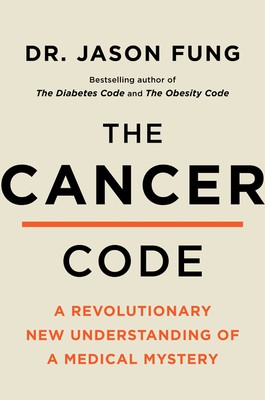
The Cancer Code by Jason Fung is a 2020 health book about cancer biology, metabolic health, insulin resistance. The genetic mutation theory of cancer, while partially correct, cannot fully explain cancer's behavior — including metastasis and drug resistance — without integrating metabolic factors.
Summary
The Cancer Code is Jason Fung's case that oncology's dominant paradigm — cancer as a genetic disease driven by somatic mutations — is incomplete and has contributed to fifty years of largely stagnant survival rates for most cancers. Fung, a Toronto nephrologist known for his work on insulin resistance and fasting, argues that viewing cancer primarily as a metabolic disease rather than a genetic one opens treatment approaches that mainstream oncology has systematically underexplored.
Fung traces the history of cancer research in three paradigms. The first, from Virchow in the nineteenth century, saw cancer as a proliferation disease. The second, which dominated the late twentieth century, identified cancer as primarily a genetic disease caused by mutations in oncogenes and tumor suppressor genes. The third, which Fung advocates, integrates the genetic view with metabolic theory: cancer cells typically rely on aerobic glycolysis (the Warburg effect) for energy even when oxygen is available, and this metabolic signature is both a cause and a consequence of the cancerous state.
The practical section of the book examines what the metabolic view implies for treatment and prevention. Fung argues that dietary interventions that reduce insulin and glucose — particularly low-carbohydrate diets and fasting — may starve cancer cells that depend on glucose while being well-tolerated by healthy cells. He reviews the emerging research on fasting in conjunction with chemotherapy, which suggests that short fasting windows before chemo both protect healthy cells and sensitize cancer cells. He is careful to note that this research is early-stage and should not lead patients to abandon proven treatments.
Fung writes accessibly and his historical framing is genuinely illuminating. The book's main limitation is that it presents an ongoing scientific debate as more settled than it is. The metabolic theory of cancer is a legitimate and growing research area, but it remains contested, and the clinical evidence for dietary interventions in human cancer is thinner than the molecular biology alone might suggest. Readers who want to understand a credible alternative to the pure genetic model will find it clearly explained; those looking for a proven alternative treatment protocol will be ahead of the evidence.
Talk to The Cancer Code like its author wrote you back.
Get the ideas that fit your life — not generic summaries.
- Chat with the book
- Audiobook-style main ideas
- Adapts to your life and goals
- Helps you take action
Key takeaways
- 1.
The genetic mutation theory of cancer, while partially correct, cannot fully explain cancer's behavior — including metastasis and drug resistance — without integrating metabolic factors.
- 2.
Most cancer cells exhibit the Warburg effect: preferential use of aerobic glycolysis even in the presence of oxygen, producing rapid ATP generation and biosynthetic precursors for growth at the expense of efficiency.
- 3.
Insulin and insulin-like growth factor 1 (IGF-1) are potent drivers of cellular proliferation; chronic hyperinsulinemia, driven by diet, creates a hormonal environment that promotes tumor growth.
- 4.
Fasting creates a metabolic state — low glucose, low insulin, elevated ketones — that may selectively stress cancer cells while protecting healthy cells through mechanisms including autophagy.
- 5.
Cancer is better understood as a spectrum of progressively dedifferentiating cells than as a binary switch from normal to malignant, which has implications for early detection and prevention strategies.
- 6.
Drug resistance in cancer evolves through the same selection dynamics as antibiotic resistance in bacteria: treatment kills susceptible cells and leaves resistant ones to proliferate.
- 7.
Prevention, not treatment, is where the metabolic theory of cancer offers the most accessible leverage — particularly through dietary patterns that reduce insulin signaling and inflammation.
- 8.
The oncology establishment's focus on tumor-shrinking endpoints in clinical trials may systematically undervalue survival-extending approaches that work through different mechanisms.
Discussion questions
Use these on your own, with a book club, or as chat starters in Superbook. Book club version, ready to copy or print →
- 1.
Fung argues that oncology has been working within an incomplete paradigm for fifty years. Does the history of how paradigms shape medical research concern you, or do you find it reassuring that the field eventually corrects itself?
- 2.
The Warburg effect — cancer cells preferring glycolysis even with oxygen available — was discovered in the 1920s. Why do you think it was largely set aside for decades before the metabolic view revived it?
- 3.
Fung makes a strong case that high insulin levels create conditions favorable for cancer growth. How does that change how you think about the long-term consequences of the standard Western diet?
- 4.
The book argues that fasting may both protect healthy cells during chemotherapy and sensitize cancer cells. If you or someone you knew were receiving chemotherapy, would you try therapeutic fasting alongside it?
- 5.
Fung is a nephrologist, not an oncologist. Does that strengthen or weaken your trust in his analysis of cancer biology and treatment?
- 6.
The book distinguishes between prevention, where the metabolic case is strongest, and treatment, where the evidence is earlier-stage. How does that distinction affect how you act on the book's recommendations?
- 7.
Drug resistance in cancer follows evolutionary dynamics: selection pressure from treatment kills susceptible cells and leaves resistant ones. What does this imply about the standard approach of treating to maximum tolerated dose?
- 8.
Fung reviews evidence suggesting that fasting before chemotherapy may improve outcomes. Why do you think clinical oncology has been slow to study this rigorously?
- 9.
The book uses the evolution analogy — cancer as a regression to a more primitive, unicellular mode — to explain its behavior. Does that framing make cancer feel more or less tractable?
- 10.
If cancer prevention is substantially achievable through metabolic health, what are the structural and economic barriers to making that the primary focus of cancer medicine?
- 11.
How does Fung's skepticism about the pharmaceutical industry's influence on oncology research feel to you — well-founded, overstated, or both?
- 12.
What one change in how you eat or live would you make based on the metabolic theory of cancer, regardless of whether you fully accept Fung's argument?
Themes
Frequently asked questions
-
What is The Cancer Code about?
The book argues that cancer is better understood as a metabolic disease than as purely a genetic one. Fung reviews the Warburg effect — cancer cells' preference for glycolysis — and the role of insulin signaling in promoting tumor growth, then discusses the implications for prevention and treatment, including fasting.
-
Does The Cancer Code recommend fasting as a cancer treatment?
It reviews emerging research on fasting in conjunction with chemotherapy and as a prevention strategy, but is explicit that this evidence is early-stage and should not lead patients to abandon proven treatments. Fung recommends using dietary approaches as adjuncts to conventional oncology, not replacements.
-
Is The Cancer Code scientifically credible?
The core claims about the Warburg effect, insulin signaling, and their relationship to cancer are grounded in legitimate and growing research. Fung's framing of this as a superior alternative to the genetic model is more contested — most oncologists view the metabolic and genetic frameworks as complementary rather than competing.
-
Who should read The Cancer Code?
People with a personal or family history of cancer who want to understand prevention from a metabolic perspective will find it valuable. It is also useful for anyone interested in the history of cancer research or in understanding how medical paradigms shift. Some background in basic biology helps but is not required.
-
How does The Cancer Code relate to Fung's other books?
It extends the insulin-resistance framework from The Obesity Code and The Diabetes Code into oncology. Readers of those books will find the metabolic argument familiar; The Cancer Code applies it to a more complex and higher-stakes disease context, with more attention to evolutionary biology.
Similar books
The Obesity Code
Jason Fung
Outlive: The Science and Art of Longevity
Peter Attia
The Emperor of All Maladies: A Biography of Cancer
Siddhartha Mukherjee
Anticancer: A New Way of Life
David Servan-Schreiber
