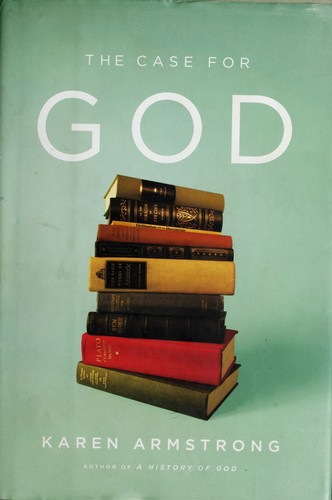
Talk to The Case for God like its author wrote you back.
Get the ideas that fit your life — not generic summaries.
- Chat with the book
- Audiobook-style main ideas
- Adapts to your life and goals
- Helps you take action
What it argues
The Case for God is Karen Armstrong's argument that the new atheism misunderstands what sophisticated religious believers in most traditions have actually claimed about God. Armstrong traces the history of religious practice and theology from the Paleolithic era through the present to show that the literalist, propositional God targeted by Richard Dawkins and Christopher Hitchens is a relatively recent construction — largely a product of modernity — not the mainstream of the Jewish, Christian, Islamic, or Buddhist traditions.
Armstrong's central distinction is between logos and mythos. Logos is the mode of rational, empirical thinking suited to solving practical problems. Mythos is the mode of symbolic, narrative thinking that addresses questions of meaning, suffering, and ultimate concern. For most of human history, religion operated in the mythic register: its stories and rituals were not meant as factual descriptions of the cosmos but as transformative practices. The God of the apophatic tradition — the tradition that says we can say nothing positive about God, only what God is not — is not a supernatural being but a symbol pointing toward a mystery beyond language.
What it gets right
- 1.
Most religious traditions distinguished between logos (rational argument) and mythos (symbolic meaning). Religion was understood as a practice, not a set of factual propositions to be believed.
- 2.
The apophatic tradition insists that nothing positive can be said about God. God is not a being among beings, not even the greatest one — 'God' points toward mystery beyond language.
- 3.
Biblical literalism and creationism are modern responses to the scientific revolution, not ancient orthodoxy. The Church Fathers read scripture allegorically as a matter of course.
What it covers
Who wrote it
Karen Armstrong is a British author and former Roman Catholic nun who left her convent in 1969 after seven years. She subsequently became one of the world's leading commentators on religion, writing more than twenty books on subjects ranging from early Christianity and Islam to the Buddha and the Hebrew Bible. Her other major works include A History of God, The Battle for God, Muhammad, Buddha, and Fields of Blood. She founded the Charter for Compassion in 2008 and has received honorary doctorates from universities in multiple countries.
