Talk to The Changing World Order like its author wrote you back.
Get the ideas that fit your life — not generic summaries.
- Chat with the book
- Audiobook-style main ideas
- Adapts to your life and goals
- Helps you take action
What it argues
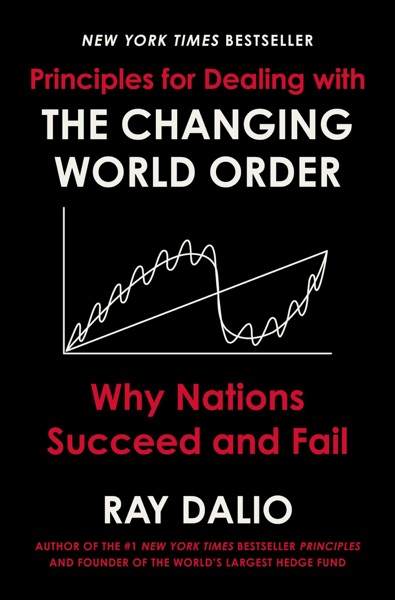
The Changing World Order is Ray Dalio's attempt to map the long arc of rising and declining empires through a systematic historical framework, with the explicit goal of understanding whether the United States is in decline and what a world with China as a co-dominant power would look like. Dalio, the founder of Bridgewater Associates, brings a macro-investor's sensibility to the task: he is less interested in narrative history than in identifying the recurring patterns that allow investors and policymakers to anticipate what comes next.
The framework at the book's center is what Dalio calls the "Big Cycle" — a roughly 250-year arc through which major world powers rise, peak, and decline. He identifies eight measures that track a country's position in this cycle: education, innovation and technology, cost competitiveness, military strength, trade, output, financial center status, and reserve currency status. He applies this framework primarily to the Dutch, British, and American empires, and uses it to argue that the United States is currently late in its cycle while China is still ascending. The comparison to Great Britain in the early twentieth century — a still-powerful but gradually declining empire facing a rising challenger — is the book's central organizing metaphor.
What it gets right
- 1.
Dalio's 'Big Cycle' describes a roughly 250-year arc from rising power to declining empire, driven by predictable interactions between debt, money, internal conflict, and external rivalry.
- 2.
Reserve currency status is both a privilege and a trap. Nations that hold the world's reserve currency can fund deficits easily — and eventually do, to the point of debasement.
- 3.
The eight determinants Dalio tracks — education, innovation, competitiveness, military, trade, output, financial status, reserve currency — tend to move together and reinforce each other in both ascent and decline.
What it covers
Who wrote it
Ray Dalio founded Bridgewater Associates in 1975 and built it into the world's largest hedge fund, managing over $150 billion at its peak. His investment philosophy centers on radical transparency, systematic macro-economic thinking, and the search for cause-and-effect relationships in economic and historical data. His previous book, Principles (2017), described his management system. The Changing World Order (2021) extends the same systematic approach to geopolitical and historical cycles. Dalio has been a participant in and observer of global monetary policy at the highest levels for over four decades.
