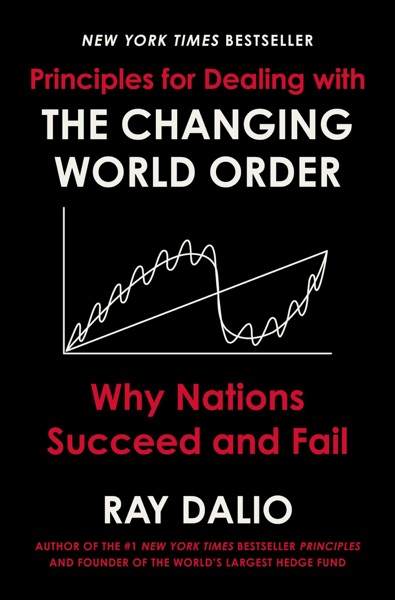
The Changing World Order by Ray Dalio is a 2021 history book about geopolitics, empire cycles, economic history. Dalio's 'Big Cycle' describes a roughly 250-year arc from rising power to declining empire, driven by predictable interactions between debt, money, internal conflict, and external rivalry.
Summary
The Changing World Order is Ray Dalio's attempt to map the long arc of rising and declining empires through a systematic historical framework, with the explicit goal of understanding whether the United States is in decline and what a world with China as a co-dominant power would look like. Dalio, the founder of Bridgewater Associates, brings a macro-investor's sensibility to the task: he is less interested in narrative history than in identifying the recurring patterns that allow investors and policymakers to anticipate what comes next.
The framework at the book's center is what Dalio calls the "Big Cycle" — a roughly 250-year arc through which major world powers rise, peak, and decline. He identifies eight measures that track a country's position in this cycle: education, innovation and technology, cost competitiveness, military strength, trade, output, financial center status, and reserve currency status. He applies this framework primarily to the Dutch, British, and American empires, and uses it to argue that the United States is currently late in its cycle while China is still ascending. The comparison to Great Britain in the early twentieth century — a still-powerful but gradually declining empire facing a rising challenger — is the book's central organizing metaphor.
Dalio gives particular attention to debt cycles and money printing. He argues that reserve currency nations have a structural temptation to print money to fund deficits, that this tends to debase the currency over time, and that the loss of reserve currency status is both a cause and consequence of imperial decline. The parallels he draws between the British Empire in 1900-1945 and the United States post-2008 are the most analytically specific sections of the book.
The book is systematic but imperfect. Dalio's models involve significant simplification, and some historians find his pattern-matching too neat — history as template rather than contingent process. The treatment of China is less critical than his treatment of Western powers, a gap readers should note. The framework is nonetheless genuinely useful as a way to structure thinking about geopolitical risk, currency exposure, and the multi-decade forces shaping the global economy. Dalio is transparent about his methodology and honest about the limits of what pattern-matching can predict.
Talk to The Changing World Order like its author wrote you back.
Get the ideas that fit your life — not generic summaries.
- Chat with the book
- Audiobook-style main ideas
- Adapts to your life and goals
- Helps you take action
Key takeaways
- 1.
Dalio's 'Big Cycle' describes a roughly 250-year arc from rising power to declining empire, driven by predictable interactions between debt, money, internal conflict, and external rivalry.
- 2.
Reserve currency status is both a privilege and a trap. Nations that hold the world's reserve currency can fund deficits easily — and eventually do, to the point of debasement.
- 3.
The eight determinants Dalio tracks — education, innovation, competitiveness, military, trade, output, financial status, reserve currency — tend to move together and reinforce each other in both ascent and decline.
- 4.
Internal wealth gaps and political polarization historically precede, and accelerate, imperial decline. The mechanism is that elites and masses lose the shared identity needed to cooperate during external stress.
- 5.
Dalio draws a direct parallel between early 20th-century Britain and present-day United States: a still-dominant power facing a rising challenger, carrying debt accumulated during previous wars, with currency prestige gradually eroding.
- 6.
China's trajectory on Dalio's eight measures shows a country still ascending, with education, trade, and manufacturing strength accelerating even as its financial markets and reserve currency status lag.
- 7.
War — internal or external — is typically the mechanism that crystallizes a transition between world orders. Dalio argues this phase of the cycle is the most dangerous to live through and the hardest to predict.
- 8.
Debt cycles overlay the imperial cycle. The short-term debt cycle (recessions) and long-term debt cycle (generational) interact with the empire cycle to produce the complexity Dalio is trying to map.
Discussion questions
Use these on your own, with a book club, or as chat starters in Superbook. Book club version, ready to copy or print →
- 1.
Dalio argues that historical patterns repeat reliably enough to use for investment and policy. How much confidence should we place in historical analogy as a guide to the future?
- 2.
The book's treatment of China is noticeably less critical than its treatment of declining Western powers. Does that asymmetry reflect analytical judgment or something else?
- 3.
Dalio identifies internal polarization and wealth gaps as drivers of decline. Looking at your own country, where do you see this mechanism operating, and how advanced is it?
- 4.
Reserve currency status gives the US advantages Dalio calls 'exorbitant privilege.' As that privilege erodes, who bears the costs first, and who bears them last?
- 5.
The Big Cycle framework involves significant simplification. What specific historical cases do you think the model handles most poorly?
- 6.
Dalio's parallel between early-20th-century Britain and contemporary America implies the transition has already started. If he's right, what decisions — personal, professional, investment — does that change?
- 7.
Dalio is an investor building an analytical framework. How should readers evaluate his historical claims given that his framework serves his investment thesis?
- 8.
The book predicts that the US-China transition will likely involve significant conflict risk. How does that probability affect how you think about the next twenty years?
- 9.
The eight measures Dalio uses to track imperial position — are there forces shaping geopolitical power that his framework misses or underweights?
- 10.
Dalio is unusually transparent about his methodology. Does that transparency make you more or less confident in his conclusions?
- 11.
Historical cycles are described in broad strokes of 50-100 years. How useful is a framework that predicts direction but not timing for decisions that need to be made in months or years?
- 12.
The Dutch Empire, British Empire, and American era each had distinct economic foundations. How much does the specific economic structure — trade, manufacturing, finance — shape how the Big Cycle plays out in each case?
Themes
Frequently asked questions
-
Is The Changing World Order worth reading?
For readers interested in macro-investing, geopolitics, or long-horizon thinking about the world economy, yes. The framework is thought-provoking and Dalio's transparency about methodology is rare in this genre. Readers who want historical nuance or a more balanced treatment of China's weaknesses may find it insufficient.
-
How does this compare to Dalio's earlier book Principles?
Principles is about Dalio's investment and management philosophy. The Changing World Order applies that systematic style to macro-history and geopolitics. They're independent — you don't need Principles to benefit from this one, though they share a methodology: build mental models, identify patterns, apply them to current events.
-
What is the Big Cycle?
Dalio's framework for the roughly 250-year rise-and-fall arc of major world powers. A new order emerges after the old one collapses, typically following war or financial crisis. Nations rise through accumulated advantages in education, innovation, trade, and finance; they decline when debt, inequality, and external rivalry overwhelm those foundations.
-
Is Dalio predicting that America will collapse?
Not collapse — decline relative to China. His argument is that the US is in a late stage of its empire cycle and China is still ascending, making the next 20 to 40 years a high-risk period of transition. He explicitly says the outcome is not predetermined and depends heavily on choices made now.
-
How long is The Changing World Order?
Around 450 pages in print, with extensive charts and appendices. At average reading pace, 8 to 10 hours. The most analytically dense sections are the ones on debt cycles and the US-China comparison — those reward slower, more careful reading.
Similar books
Principles
Ray Dalio
Sapiens: A Brief History of Humankind
Yuval Noah Harari
Guns, Germs, and Steel
Jared Diamond
Why Nations Fail: The Origins of Power, Prosperity, and Poverty
Daron Acemoglu and James A. Robinson
