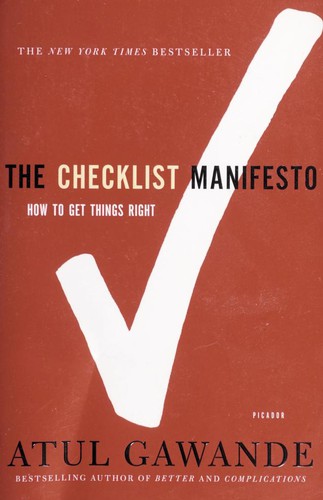
Talk to The Checklist Manifesto like its author wrote you back.
Get the ideas that fit your life — not generic summaries.
- Chat with the book
- Audiobook-style main ideas
- Adapts to your life and goals
- Helps you take action
What it argues
The Checklist Manifesto is Atul Gawande's argument that the single most underused tool for preventing catastrophic failure in complex fields is also the simplest: a well-designed checklist. Gawande starts from a basic observation — that surgery, aviation, construction, and finance have all become so complicated that no single expert, however skilled, can reliably hold every critical step in mind under pressure. The result is not incompetence but what he calls "errors of ineptitude": failures caused by not applying what we already know, rather than by not knowing enough.
The book's central case study is the WHO Surgical Safety Checklist, a nineteen-item list developed after Gawande studied what made aviation safe. When piloted in eight hospitals across different countries, the checklist cut major complications by 36 percent and deaths by 47 percent. The mechanism is not magic. Checklists enforce communication at key moments, prompt team members to check each other's assumptions, and create a shared mental model before high-stakes tasks begin. They don't replace skill. They create the conditions under which skill can be deployed reliably.
What it gets right
- 1.
Modern professions have grown so complex that even experts regularly fail not from ignorance but from failing to apply knowledge they already possess. Gawande calls these 'errors of ineptitude.'
- 2.
A well-designed checklist is not a dumbing-down of expertise. It is the tool that allows expertise to function reliably under the real conditions of pressure, distraction, and competing demands.
- 3.
The WHO Surgical Safety Checklist cut major surgical complications by 36 percent and deaths by 47 percent across hospitals in eight countries — one of the largest improvements in patient safety ever recorded.
What it covers
Who wrote it
Atul Gawande is a surgeon, public health researcher, and staff writer at The New Yorker. He is the author of several books including Complications, Better, and Being Mortal, each examining how medicine actually works against how it is supposed to. Gawande is a professor at Harvard Medical School and the Harvard T.H. Chan School of Public Health. He served as a senior adviser in the Department of Health and Human Services and has written extensively on end-of-life care, healthcare systems, and the limits of expertise.
