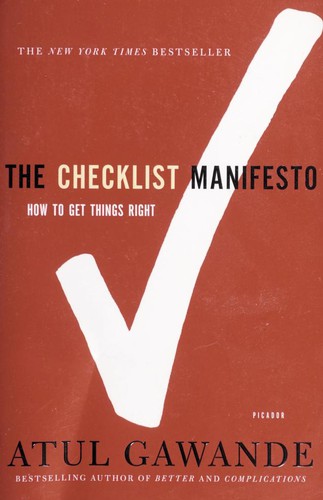
The Checklist Manifesto by Atul Gawande is a 2009 health book about checklists, complexity, decision-making. Modern professions have grown so complex that even experts regularly fail not from ignorance but from failing to apply knowledge they already possess. Gawande calls these 'errors of ineptitude.'
Summary
The Checklist Manifesto is Atul Gawande's argument that the single most underused tool for preventing catastrophic failure in complex fields is also the simplest: a well-designed checklist. Gawande starts from a basic observation — that surgery, aviation, construction, and finance have all become so complicated that no single expert, however skilled, can reliably hold every critical step in mind under pressure. The result is not incompetence but what he calls "errors of ineptitude": failures caused by not applying what we already know, rather than by not knowing enough.
The book's central case study is the WHO Surgical Safety Checklist, a nineteen-item list developed after Gawande studied what made aviation safe. When piloted in eight hospitals across different countries, the checklist cut major complications by 36 percent and deaths by 47 percent. The mechanism is not magic. Checklists enforce communication at key moments, prompt team members to check each other's assumptions, and create a shared mental model before high-stakes tasks begin. They don't replace skill. They create the conditions under which skill can be deployed reliably.
Gawande extends the argument beyond medicine. He examines how construction foremen use coordinating checklists to manage thousands of variables on a skyscraper project, and how the best venture capitalists in Silicon Valley have developed quiet investment checklists to guard against enthusiasm overriding judgment. The lesson in each domain is the same: checklists are not for the routine. They are for the moments when complexity outpaces any individual's working memory, and when the cost of forgetting a single step is irreversible.
The book has a narrow thesis and makes no apology for it. Gawande is not arguing that checklists fix every problem or substitute for training and expertise. He is arguing that for a specific category of failure — the failure to consistently do what is already known to be right — checklists are the cheapest, most proven fix available, and that professional culture's resistance to using them is a form of pride masquerading as competence. The case is carefully made, though readers who want broader frameworks for organizational improvement may find the argument too focused on a single instrument.
Talk to The Checklist Manifesto like its author wrote you back.
Get the ideas that fit your life — not generic summaries.
- Chat with the book
- Audiobook-style main ideas
- Adapts to your life and goals
- Helps you take action
Key takeaways
- 1.
Modern professions have grown so complex that even experts regularly fail not from ignorance but from failing to apply knowledge they already possess. Gawande calls these 'errors of ineptitude.'
- 2.
A well-designed checklist is not a dumbing-down of expertise. It is the tool that allows expertise to function reliably under the real conditions of pressure, distraction, and competing demands.
- 3.
The WHO Surgical Safety Checklist cut major surgical complications by 36 percent and deaths by 47 percent across hospitals in eight countries — one of the largest improvements in patient safety ever recorded.
- 4.
Checklists work partly by enforcing team communication at defined moments. The most valuable items are not reminders to individuals but prompts that require people to speak to each other and check assumptions out loud.
- 5.
There are two kinds of checklists: DO-CONFIRM, where a team works from memory then checks the list afterward, and READ-DO, where they follow the list step by step. The right type depends on the task.
- 6.
Good checklists are short. The instinct to make them comprehensive makes them useless. A checklist should capture only the critical steps that are most likely to be missed and most consequential if skipped.
- 7.
Aviation's safety record was not built on better pilots alone. It was built by systematically transferring individual knowledge into shared procedures — a model that medicine adopted late and reluctantly.
- 8.
Professional resistance to checklists often comes from a sense that following a list is beneath expert dignity. Gawande argues this resistance kills people and costs money, and that the best professionals in aviation and construction have already moved past it.
Discussion questions
Use these on your own, with a book club, or as chat starters in Superbook. Book club version, ready to copy or print →
- 1.
Gawande distinguishes between errors of ignorance and errors of ineptitude. Which type do you encounter more often in your own work, and what conditions tend to trigger them?
- 2.
He argues that professional pride is one of the main barriers to adopting checklists. Where in your field do you see that resistance, and what does it look like in practice?
- 3.
Think of a task in your life — professional or personal — that has become complex enough to benefit from a checklist. What would be on it?
- 4.
The book stresses that checklists should be short. What's the hardest part of deciding what to leave off?
- 5.
Gawande describes checklists that force team members to speak to each other rather than just check boxes individually. What problems in your work could be addressed by requiring that kind of forced communication?
- 6.
The aviation industry's safety improvements came from treating pilot error as a systems problem rather than an individual failing. Does your field do the same, or does it default to blaming individuals?
- 7.
The WHO checklist improved outcomes even in hospitals where staff were initially skeptical or resistant. What does that suggest about how to implement new protocols in organizations where buy-in is low?
- 8.
Gawande draws a distinction between simple, complicated, and complex problems. How does that framework apply to the biggest challenges in your work?
- 9.
The venture capitalists in the book kept quiet checklists to override their own enthusiasm. What biases in your own decision-making might a personal checklist help guard against?
- 10.
The book was published in 2009. In what ways has the argument aged well, and where do you think the limits of the checklist idea have become clearer since then?
- 11.
Gawande is a surgeon writing partly about his own profession's failures. Does it change how you receive the argument that the critique comes from inside the field rather than outside it?
- 12.
What would it take for checklists to be genuinely adopted in a domain you know — not just mandated on paper but actually followed under pressure?
Themes
Frequently asked questions
-
Is The Checklist Manifesto worth reading?
Yes, if you work in any field where mistakes are costly and complexity has outpaced individual memory. The argument is narrow but airtight, and the case studies from surgery, aviation, and finance are genuinely surprising. If you mainly want broad productivity advice, the book's tight focus may feel limiting.
-
How long does it take to read The Checklist Manifesto?
Around four hours at average reading pace for the 209-page book. It's one of Gawande's shorter books and reads quickly. The chapters are dense with examples rather than abstract theory, which makes them easy to move through.
-
What is the main argument of The Checklist Manifesto?
That a well-designed checklist is one of the most effective tools ever developed for preventing catastrophic failure in complex fields, and that professional culture's resistance to using them costs lives and money in medicine, aviation, construction, and finance.
-
Who should read this book?
Surgeons, pilots, and engineers are the obvious audience, but the book is most surprising to readers who don't think of their work as checklist-amenable. Managers, investors, and anyone running high-stakes recurring processes will find the framework useful.
-
What's the most actionable idea in The Checklist Manifesto?
Build a short checklist for the highest-stakes repeating task in your work — not comprehensive, just the five to nine steps most likely to be skipped under pressure. Test it for a month and see how many near-misses it catches.
-
Does the book only apply to medicine and aviation?
No. Gawande deliberately extends the case to construction project management and venture capital to show the principle is general. Wherever complexity outpaces individual working memory and failure is irreversible, checklists apply.
Similar books
Thinking, Fast and Slow
Daniel Kahneman
Nudge: Improving Decisions About Health, Wealth, and Happiness
Richard H. Thaler and Cass R. Sunstein
Outliers: The Story of Success
Malcolm Gladwell
Behave: The Biology of Humans at Our Best and Worst
Robert M. Sapolsky
