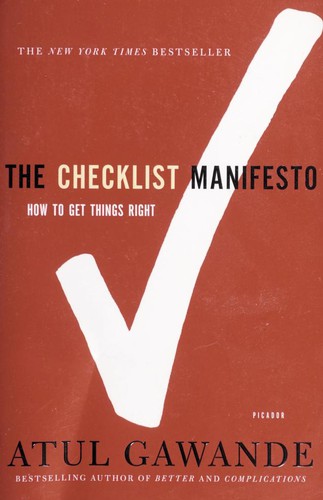
Talk to The Checklist Manifesto like its author wrote you back.
Get the ideas that fit your life — not generic summaries.
- Chat with the book
- Audiobook-style main ideas
- Adapts to your life and goals
- Helps you take action
The Checklist Manifesto, in detail
The Checklist Manifesto is Atul Gawande's argument that the single most underused tool for preventing catastrophic failure in complex fields is also the simplest: a well-designed checklist. Gawande starts from a basic observation — that surgery, aviation, construction, and finance have all become so complicated that no single expert, however skilled, can reliably hold every critical step in mind under pressure. The result is not incompetence but what he calls "errors of ineptitude": failures caused by not applying what we already know, rather than by not knowing enough.
The book's central case study is the WHO Surgical Safety Checklist, a nineteen-item list developed after Gawande studied what made aviation safe. When piloted in eight hospitals across different countries, the checklist cut major complications by 36 percent and deaths by 47 percent. The mechanism is not magic. Checklists enforce communication at key moments, prompt team members to check each other's assumptions, and create a shared mental model before high-stakes tasks begin. They don't replace skill. They create the conditions under which skill can be deployed reliably.
Gawande extends the argument beyond medicine. He examines how construction foremen use coordinating checklists to manage thousands of variables on a skyscraper project, and how the best venture capitalists in Silicon Valley have developed quiet investment checklists to guard against enthusiasm overriding judgment. The lesson in each domain is the same: checklists are not for the routine. They are for the moments when complexity outpaces any individual's working memory, and when the cost of forgetting a single step is irreversible.
The book has a narrow thesis and makes no apology for it. Gawande is not arguing that checklists fix every problem or substitute for training and expertise. He is arguing that for a specific category of failure — the failure to consistently do what is already known to be right — checklists are the cheapest, most proven fix available, and that professional culture's resistance to using them is a form of pride masquerading as competence. The case is carefully made, though readers who want broader frameworks for organizational improvement may find the argument too focused on a single instrument.
The big ideas
- 1.
Modern professions have grown so complex that even experts regularly fail not from ignorance but from failing to apply knowledge they already possess. Gawande calls these 'errors of ineptitude.'
- 2.
A well-designed checklist is not a dumbing-down of expertise. It is the tool that allows expertise to function reliably under the real conditions of pressure, distraction, and competing demands.
- 3.
The WHO Surgical Safety Checklist cut major surgical complications by 36 percent and deaths by 47 percent across hospitals in eight countries — one of the largest improvements in patient safety ever recorded.
