Talk to The China Study like its author wrote you back.
Get the ideas that fit your life — not generic summaries.
- Chat with the book
- Audiobook-style main ideas
- Adapts to your life and goals
- Helps you take action
The China Study, in detail
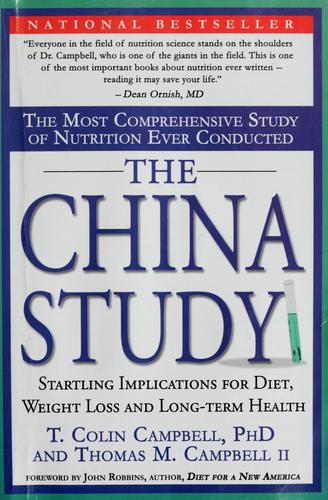
The China Study is T. Colin Campbell's account of the China-Cornell-Oxford Project, a twenty-year study of diet and disease patterns across sixty-five rural counties in China, and his broader argument that animal protein — particularly casein from dairy — is the most significant dietary driver of cancer, heart disease, and other chronic Western diseases. Campbell, a nutritional biochemist, has spent decades researching the relationship between protein intake and cancer. The book is both a scientific report and a personal manifesto, and it does not pretend to neutrality.
The core empirical claim is that populations eating the most animal protein have the highest rates of the chronic diseases that kill most Westerners, while populations eating predominantly plant-based diets have dramatically lower rates of these diseases. The China study is the centerpiece: China in the 1970s and 80s offered a natural experiment because rural populations ate very different diets across regions, and the variation in disease rates correlated with animal food consumption. Campbell supplements this with laboratory findings, particularly experiments in rats showing that dietary casein reliably promotes tumor growth when consumption exceeds ten percent of calories.
The second half of the book is more polemical, arguing that the medical and pharmaceutical industries have structural incentives to suppress dietary interventions that could reduce the market for drugs, and that the USDA's dietary guidelines are compromised by industry influence. These claims are more speculative than the empirical material but consistent with what other food researchers have documented about the conflicts of interest in nutritional science.
The book has attracted sustained methodological criticism. Denise Minger and others have argued that Campbell's interpretation of the China data is selective — that the raw correlations are more mixed than presented, and that the diet-disease links are weaker than claimed once confounders are accounted for. Campbell's experimental work on casein has also been challenged as not readily generalizable from rat studies to human dietary patterns. Readers are well-served by approaching the book as an important but contested contribution rather than the definitive word on diet and disease.
The big ideas
- 1.
The China Study's central finding is that animal protein consumption correlates with rates of Western chronic diseases across Chinese counties — heart disease, cancer, and diabetes rise with animal food intake.
- 2.
Laboratory experiments found that dietary casein reliably promotes cancer tumor growth in rats above ten percent of caloric intake, while plant proteins did not produce the same effect.
- 3.
Whole-food, plant-based diets have been associated not just with prevention but with reversal of heart disease in Ornish-style clinical programs.
