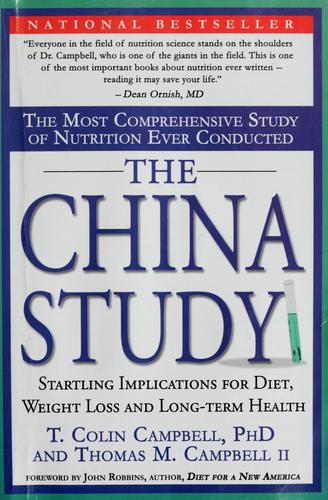
The China Study by T. Colin Campbell is a 2005 health book about nutrition, plant-based diet, cancer prevention. The China Study's central finding is that animal protein consumption correlates with rates of Western chronic diseases across Chinese counties — heart disease, cancer, and diabetes rise with animal food intake.
Summary
The China Study is T. Colin Campbell's account of the China-Cornell-Oxford Project, a twenty-year study of diet and disease patterns across sixty-five rural counties in China, and his broader argument that animal protein — particularly casein from dairy — is the most significant dietary driver of cancer, heart disease, and other chronic Western diseases. Campbell, a nutritional biochemist, has spent decades researching the relationship between protein intake and cancer. The book is both a scientific report and a personal manifesto, and it does not pretend to neutrality.
The core empirical claim is that populations eating the most animal protein have the highest rates of the chronic diseases that kill most Westerners, while populations eating predominantly plant-based diets have dramatically lower rates of these diseases. The China study is the centerpiece: China in the 1970s and 80s offered a natural experiment because rural populations ate very different diets across regions, and the variation in disease rates correlated with animal food consumption. Campbell supplements this with laboratory findings, particularly experiments in rats showing that dietary casein reliably promotes tumor growth when consumption exceeds ten percent of calories.
The second half of the book is more polemical, arguing that the medical and pharmaceutical industries have structural incentives to suppress dietary interventions that could reduce the market for drugs, and that the USDA's dietary guidelines are compromised by industry influence. These claims are more speculative than the empirical material but consistent with what other food researchers have documented about the conflicts of interest in nutritional science.
The book has attracted sustained methodological criticism. Denise Minger and others have argued that Campbell's interpretation of the China data is selective — that the raw correlations are more mixed than presented, and that the diet-disease links are weaker than claimed once confounders are accounted for. Campbell's experimental work on casein has also been challenged as not readily generalizable from rat studies to human dietary patterns. Readers are well-served by approaching the book as an important but contested contribution rather than the definitive word on diet and disease.
Talk to The China Study like its author wrote you back.
Get the ideas that fit your life — not generic summaries.
- Chat with the book
- Audiobook-style main ideas
- Adapts to your life and goals
- Helps you take action
Key takeaways
- 1.
The China Study's central finding is that animal protein consumption correlates with rates of Western chronic diseases across Chinese counties — heart disease, cancer, and diabetes rise with animal food intake.
- 2.
Laboratory experiments found that dietary casein reliably promotes cancer tumor growth in rats above ten percent of caloric intake, while plant proteins did not produce the same effect.
- 3.
Whole-food, plant-based diets have been associated not just with prevention but with reversal of heart disease in Ornish-style clinical programs.
- 4.
The USDA and institutional nutrition science have structural conflicts of interest — industry funding and revolving doors between industry and regulatory bodies — that bias dietary recommendations.
- 5.
Western medicine's focus on pharmaceutical and surgical treatment of chronic disease creates financial incentives to underinvest in dietary prevention.
- 6.
The strongest natural experiment in the book is the comparison of largely plant-based rural Chinese diets with Western diets, showing dramatically lower rates of the leading killers.
- 7.
Protein from whole plant sources (legumes, grains, vegetables) appears to provide all required amino acids without the disease-promoting effects associated with animal protein.
- 8.
Nutritional reductionism — studying individual nutrients rather than whole dietary patterns — has been a barrier to understanding how diet affects health at the systems level.
Discussion questions
Use these on your own, with a book club, or as chat starters in Superbook. Book club version, ready to copy or print →
- 1.
Campbell's argument rests heavily on correlations from epidemiological data. What would it take for that kind of evidence to convince you to make major dietary changes?
- 2.
The book makes strong claims about casein and cancer based largely on rat studies. How much weight do you give animal research when drawing conclusions about human health?
- 3.
Campbell argues that industry influence corrupts nutritional science and dietary guidelines. Do you find that plausible? What would change if it were true?
- 4.
If the core claims of The China Study are correct, the implication is that the standard American diet is slowly killing most Americans. Why do you think that message hasn't produced more widespread dietary change?
- 5.
Methodological critics have argued Campbell interprets the China data selectively. How do you evaluate a book's scientific claims when you lack the expertise to read the underlying studies yourself?
- 6.
The book argues that whole-food, plant-based eating can reverse heart disease. Does that claim change how you think about the role of diet versus medication in treating chronic conditions?
- 7.
Campbell grew up on a dairy farm and spent his early career promoting animal protein before the data changed his view. How does knowing about his personal journey affect your reading of his conclusions?
- 8.
The book covers the relationship between meat and dairy industries and public health recommendations. Does that change how you think about where dietary guidelines come from?
- 9.
If you could do one thing based on the book's recommendations, what would it be? What's the main obstacle?
- 10.
Campbell argues that reductionist nutritional science — studying individual nutrients — has failed. What would a more holistic nutritional science look like?
- 11.
The book recommends eliminating all animal products. Do you think that's a realistic prescription for most people? What would make it more achievable?
- 12.
How does The China Study compare to other dietary arguments you've encountered? What makes it more or less compelling than those?
Themes
Frequently asked questions
-
Is The China Study scientifically reliable?
It is an important but contested work. The empirical claims about Chinese dietary patterns and disease rates are based on real data, but critics — most notably nutritional blogger Denise Minger — have argued that Campbell's interpretation of the data is selective and that the correlations are weaker than presented. The rat studies on casein are credible but may not generalize to human diets. Treat it as a strong argument for one position, not the final word.
-
What is the main argument of The China Study?
That animal protein, particularly casein from dairy, is the primary dietary driver of cancer, heart disease, and other chronic diseases, and that a whole-food, plant-based diet is the most powerful tool for preventing and reversing these conditions.
-
How does The China Study differ from How Not to Die?
Both argue for plant-based diets, but The China Study is more focused on a specific research project and a single mechanism — animal protein as a cancer promoter. Greger's How Not to Die is broader, covering fifteen diseases and synthesizing a much wider body of research.
-
Who should read The China Study?
Anyone interested in the most influential argument for whole-food, plant-based eating from a scientific perspective. Also useful for people who want to understand the debate about animal protein and cancer. Read it alongside critiques for a balanced view.
-
What are the main criticisms of The China Study?
That the China data shows more complex and mixed correlations than Campbell presents, that cherry-picking may have occurred in selecting which correlations to highlight, and that rat studies on casein may not generalize to whole dietary patterns in humans.