Talk to The Choice like its author wrote you back.
Get the ideas that fit your life — not generic summaries.
- Chat with the book
- Audiobook-style main ideas
- Adapts to your life and goals
- Helps you take action
What it argues
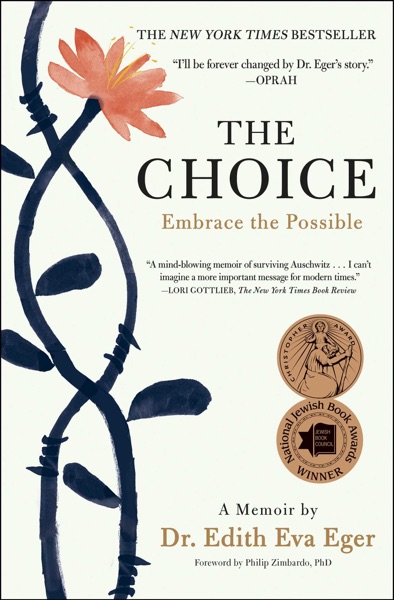
Edith Eva Eger was sixteen years old when she arrived at Auschwitz-Birkenau in May 1944. On the selection platform, Josef Mengele asked if the young girl beside her was her mother or sister. Eger said "mother." Her mother was sent to the gas chamber immediately. Eger survived, along with her sister Magda, through a combination of luck, physical endurance, and a capacity for inner freedom she later came to understand as the defining fact of her life.
The Choice is structured in three parts. The first covers her girlhood in Košice, Czechoslovakia, her early love of ballet and dreams of becoming a professional dancer, her first love, and the German occupation that ended all of it. The second covers Auschwitz, the death marches that followed liberation, and the years of silence and numbness that Eger carried into her emigration to America. The third, and in some ways the most valuable, covers her training as a psychologist — she completed her PhD at age fifty — and her decades of clinical work helping others process trauma. It is here that the title becomes most clearly her subject: the choice to remain a victim or to become a survivor, to carry the prison inside or to unlock it.
What it gets right
- 1.
The choice Eger describes is not the choice of circumstances but the choice of inner response. In Auschwitz, with no external freedom, she maintained an inner life — dancing in her mind for Mengele — that no captor could reach.
- 2.
Survival guilt is one of the most persistent and damaging legacies of trauma. Eger spent decades believing she had survived at the cost of her mother's death and had to work through that belief to reach genuine freedom.
- 3.
Victor Frankl's influence is explicit throughout the book. His central claim — that meaning can be found in any circumstance, that the last human freedom is the choice of attitude — is the framework Eger built her clinical practice on.
What it covers
Who wrote it
Edith Eva Eger was born in 1927 in Košice, Czechoslovakia, and survived Auschwitz-Birkenau, Gunskirchen, and multiple death marches before being liberated in 1945. She emigrated to the United States, eventually completing a PhD in psychology from William University at age fifty. She practiced as a clinical psychologist in El Paso, Texas, for decades and worked extensively with US military veterans suffering from PTSD. The Choice, her memoir and first book, was published when she was ninety years old. Her second book, The Gift, extends the clinical framework introduced in The Choice. She lives in La Jolla, California.
