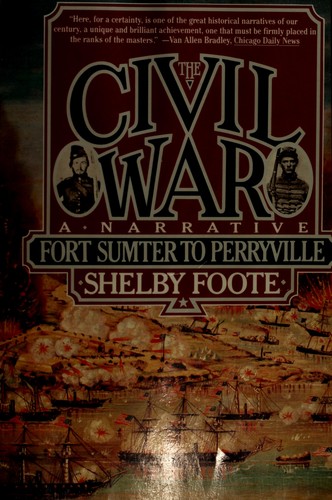
Talk to The Civil War: A Narrative like its author wrote you back.
Get the ideas that fit your life — not generic summaries.
- Chat with the book
- Audiobook-style main ideas
- Adapts to your life and goals
- Helps you take action
What it argues
Shelby Foote spent twenty years writing this three-volume, 1.5-million-word account of the American Civil War, and the result is one of the most ambitious narrative history projects ever attempted by a single author. The work covers the conflict from Fort Sumter in 1861 through the assassination of Lincoln in 1865, drawing on original documents, memoirs, and battle reports to create something closer to a novel in texture than a conventional military history.
Foote wrote as a Mississippian who was deeply absorbed in the war's human dimensions. He gives equal weight to both sides, tracing the war through individual personalities rather than through abstraction. Ulysses Grant, William Sherman, Jefferson Davis, Robert E. Lee, and dozens of lesser-known officers emerge as full characters with consistent voices across all three volumes. The battle sequences — Shiloh, Chancellorsville, Gettysburg, Vicksburg, the Wilderness — are rendered with a clarity that makes the chaos of nineteenth-century combat comprehensible without reducing it to chess-move simplicity.
What it gets right
- 1.
The Civil War was not a series of discrete battles but a continuous, grinding attrition in which logistics, morale, and political will shaped outcomes as much as battlefield tactics.
- 2.
Robert E. Lee and Ulysses Grant emerge as opposing archetypes: Lee's aggressive genius and limited resources against Grant's relentless operational pressure and superior supply.
- 3.
Jefferson Davis's leadership failures — his preference for micromanagement, his personal feuds with subordinates, his inability to unite Confederate political factions — were as damaging to the South as any Union military victory.
What it covers
Who wrote it
Shelby Foote (1916–2005) was a Mississippi-born novelist and historian. He published five novels before beginning his Civil War trilogy in 1954, and the project consumed the next two decades of his life. The three volumes appeared in 1958, 1963, and 1974. His prominence expanded greatly after his appearances in Ken Burns's 1990 documentary series, which introduced his prose to a broad national audience. He received the Dos Passos Prize for Literature and was a longtime friend of fellow Mississippi writer Walker Percy.
