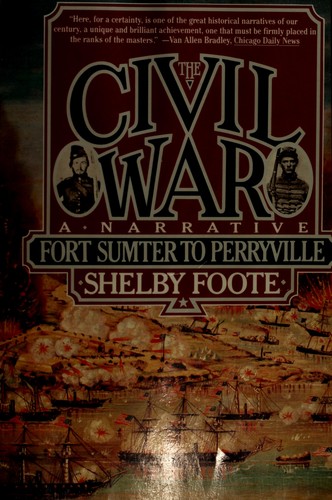
Talk to The Civil War: A Narrative like its author wrote you back.
Get the ideas that fit your life — not generic summaries.
- Chat with the book
- Audiobook-style main ideas
- Adapts to your life and goals
- Helps you take action
The Civil War: A Narrative, in detail
Shelby Foote spent twenty years writing this three-volume, 1.5-million-word account of the American Civil War, and the result is one of the most ambitious narrative history projects ever attempted by a single author. The work covers the conflict from Fort Sumter in 1861 through the assassination of Lincoln in 1865, drawing on original documents, memoirs, and battle reports to create something closer to a novel in texture than a conventional military history.
Foote wrote as a Mississippian who was deeply absorbed in the war's human dimensions. He gives equal weight to both sides, tracing the war through individual personalities rather than through abstraction. Ulysses Grant, William Sherman, Jefferson Davis, Robert E. Lee, and dozens of lesser-known officers emerge as full characters with consistent voices across all three volumes. The battle sequences — Shiloh, Chancellorsville, Gettysburg, Vicksburg, the Wilderness — are rendered with a clarity that makes the chaos of nineteenth-century combat comprehensible without reducing it to chess-move simplicity.
The work has been criticized by academic historians for occasionally soft-pedaling the centrality of slavery to the Confederate cause. Foote was a novelist before he was a historian, and that lineage shows in his tendency to pursue dramatic coherence over ideological argument. His sympathies are complicated — he admired Confederate valor while acknowledging the war's moral outcome — and readers who want a more direct engagement with slavery and race may find him evasive. That said, no other single work conveys the full scale of the war's human cost with comparable immediacy.
The trilogy's longevity owes a great deal to Ken Burns's 1990 PBS documentary, in which Foote appeared extensively and introduced a generation of Americans to his prose. But the books existed long before that and reward readers who approach them as literature. They are a reminder that historical narrative, done at this level of craft, can make a dead century feel immediate.
The big ideas
- 1.
The Civil War was not a series of discrete battles but a continuous, grinding attrition in which logistics, morale, and political will shaped outcomes as much as battlefield tactics.
- 2.
Robert E. Lee and Ulysses Grant emerge as opposing archetypes: Lee's aggressive genius and limited resources against Grant's relentless operational pressure and superior supply.
- 3.
Jefferson Davis's leadership failures — his preference for micromanagement, his personal feuds with subordinates, his inability to unite Confederate political factions — were as damaging to the South as any Union military victory.
