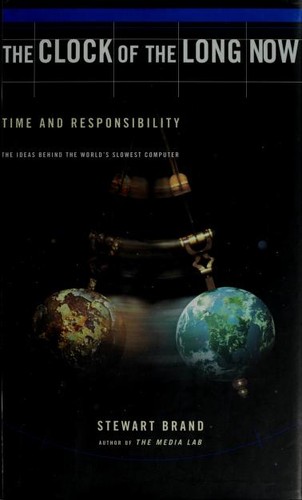
Talk to The Clock of the Long Now like its author wrote you back.
Get the ideas that fit your life — not generic summaries.
- Chat with the book
- Audiobook-style main ideas
- Adapts to your life and goals
- Helps you take action
What it argues
The Clock of the Long Now is Stewart Brand's case for thinking at a civilizational scale rather than a quarterly one. It grew out of Brand's work with the Long Now Foundation, which he cofounded with Brian Eno and others in 1996 with the explicit goal of building a clock designed to run for ten thousand years — a physical artifact that would make long-term thinking tangible and culturally compelling. The book is part manifesto, part design document, part meditation on what long-term responsibility actually requires.
Brand's core argument is organized around what he calls the Pace Layers: a hierarchy of change rates that govern complex civilizations. Fashion and art change fastest. Commerce is slightly slower. Infrastructure slower still. Governance slower. Culture slower. Nature slowest of all. The layers interact — fast layers learn and experiment; slow layers provide stability and memory — and civilization depends on this hierarchy functioning properly. When fast layers try to override slow ones (short-term financial incentives reshaping governance) or slow layers refuse to absorb lessons from fast ones, things go wrong.
What it gets right
- 1.
The Pace Layers model: civilization operates across six layers — Fashion, Commerce, Infrastructure, Governance, Culture, Nature — each changing at a different rate. Stability comes from the slower layers; adaptability from the faster ones.
- 2.
Short-term incentives systematically override long-term thinking in democratic politics and financial markets, producing decisions that are locally rational but collectively destructive.
- 3.
A physical artifact designed for ten-thousand-year operation forces you to think concretely about what structures, materials, and institutions could actually survive that long.
What it covers
Who wrote it
Stewart Brand is an American writer, ecologist, and futurist who founded the Whole Earth Catalog in 1968. He cofounded the Long Now Foundation in 1996 and has been one of its central voices for decades. His other books include How Buildings Learn, Whole Earth Discipline, and The Media Lab. Brand has been associated with the California counterculture, the early personal computing community, and environmental thinking since the 1960s, and has consistently argued for the compatibility of technology and ecological responsibility.
