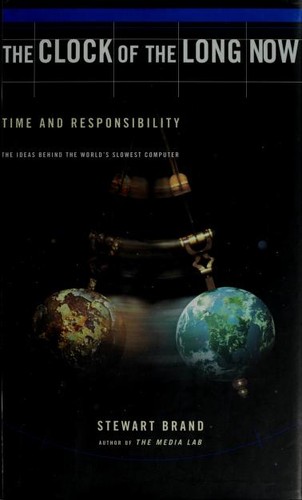
The Clock of the Long Now by Stewart Brand is a 1999 philosophy book about long-term thinking, civilization, technology. The Pace Layers model: civilization operates across six layers — Fashion, Commerce, Infrastructure, Governance, Culture, Nature — each changing at a different rate. Stability comes from the slower layers; adaptability from the faster ones.
Summary
The Clock of the Long Now is Stewart Brand's case for thinking at a civilizational scale rather than a quarterly one. It grew out of Brand's work with the Long Now Foundation, which he cofounded with Brian Eno and others in 1996 with the explicit goal of building a clock designed to run for ten thousand years — a physical artifact that would make long-term thinking tangible and culturally compelling. The book is part manifesto, part design document, part meditation on what long-term responsibility actually requires.
Brand's core argument is organized around what he calls the Pace Layers: a hierarchy of change rates that govern complex civilizations. Fashion and art change fastest. Commerce is slightly slower. Infrastructure slower still. Governance slower. Culture slower. Nature slowest of all. The layers interact — fast layers learn and experiment; slow layers provide stability and memory — and civilization depends on this hierarchy functioning properly. When fast layers try to override slow ones (short-term financial incentives reshaping governance) or slow layers refuse to absorb lessons from fast ones, things go wrong.
The book was written at the height of Y2K anxiety, which gives several chapters a specific historical texture, but the underlying concern — that contemporary civilization thinks in years when it should think in centuries — has only become more urgent. Brand draws on the physical design of the ten-thousand-year clock itself as a way of concretizing the question: what kind of maintenance schedule would you write for a machine that has to outlast every organization currently alive? What social and material structures would you design around it?
The Long Now project is also a meditation on responsibility to the future. Brand asks what we owe to people who do not exist yet, and what kinds of decisions made now will constrain or enable their choices. He is not alarmist — the tone is optimistic about civilization's capacity for long thinking when prompted — but he is clear-eyed about how much contemporary culture and economics actively discourage it.
Talk to The Clock of the Long Now like its author wrote you back.
Get the ideas that fit your life — not generic summaries.
- Chat with the book
- Audiobook-style main ideas
- Adapts to your life and goals
- Helps you take action
Key takeaways
- 1.
The Pace Layers model: civilization operates across six layers — Fashion, Commerce, Infrastructure, Governance, Culture, Nature — each changing at a different rate. Stability comes from the slower layers; adaptability from the faster ones.
- 2.
Short-term incentives systematically override long-term thinking in democratic politics and financial markets, producing decisions that are locally rational but collectively destructive.
- 3.
A physical artifact designed for ten-thousand-year operation forces you to think concretely about what structures, materials, and institutions could actually survive that long.
- 4.
The five Cs of long-term thinking: continuity, room to maneuver, distributed complexity, precautionary principle, and the obligation to leave options open for future generations.
- 5.
Most software and digital infrastructure is designed without any consideration for longevity. Digital obsolescence is as real a threat to cultural memory as physical decay.
- 6.
Fast layers can send signals upward to slow layers, but the relationship is asymmetric — slow layers set the parameters within which fast layers operate, not the reverse.
- 7.
Civilization-scale thinking requires institutions with long time horizons: religions, universities, families. The erosion of these institutions removes the social infrastructure for thinking beyond the immediate.
Discussion questions
Use these on your own, with a book club, or as chat starters in Superbook. Book club version, ready to copy or print →
- 1.
Brand's Pace Layers model suggests civilization depends on different layers changing at different rates. What happens in your own organization or community when a fast layer tries to override a slow one?
- 2.
The ten-thousand-year clock is a physical way of making long thinking tangible. Are there other artifacts or practices in your life that anchor you to a longer time horizon?
- 3.
He argues that digital infrastructure is uniquely fragile because of rapid obsolescence. What digital files or projects do you have that you expect to be accessible in twenty years?
- 4.
Brand wrote the book partly in response to Y2K panic. How does short-term crisis thinking interact with long-term responsibility in current issues you care about?
- 5.
What decisions made in the last fifty years do you think will most constrain the options available to people in the next hundred?
- 6.
He is relatively optimistic that civilization can think long when given the right prompts and institutions. Does that optimism seem warranted to you now?
- 7.
The book implies that some institutions — religions, universities — carry longer time horizons than corporations or governments. Is that still true? What institutions in your life think long?
- 8.
Brand distinguishes between leaving options open and making decisions. Is there a domain in your life where you're systematically foreclosing future options without realizing it?
- 9.
The Long Now Foundation uses 02024 rather than 2024 in its dates. That small typographic choice is meant to shift attention. Do you find it works, or does it feel like an affectation?
- 10.
What responsibilities, if any, do you feel toward people who will be alive in a hundred years? How does your answer compare to what you actually do?
- 11.
How does the Pace Layers model apply to your own field of work? Which layer does your work primarily operate in, and where is the friction with adjacent layers?
Themes
Frequently asked questions
-
What is the Long Now Foundation?
An organization cofounded by Brand, Brian Eno, Danny Hillis, and others in 1996 with the goal of building a ten-thousand-year clock and fostering long-term thinking more broadly. It runs a seminar series, a music library of extremely slow compositions, and the Rosetta Project for preserving endangered languages.
-
Is The Clock of the Long Now still relevant given how much has changed since 1999?
Yes, more than ever. The arguments about digital obsolescence, short-term incentive structures in finance and politics, and the erosion of institutions with long time horizons have all intensified since 1999. The Y2K framing dates some passages, but the underlying concerns are more urgent.
-
What is the Pace Layers model?
Brand's framework for understanding how civilization operates across six layers — Fashion, Commerce, Infrastructure, Governance, Culture, Nature — each changing at a different rate. Fast layers provide adaptability; slow layers provide stability. The interaction between them is what makes civilization resilient or fragile.
-
How long is the book?
Around 190 pages, readable in four to five hours. Brand writes in a compressed, essayistic style. The book rewards slow reading and rereading more than it rewards speed.
-
Has the ten-thousand-year clock actually been built?
A prototype exists and a full-scale clock is under construction inside a mountain in western Texas, funded largely by Jeff Bezos. As of the mid-2020s, construction is ongoing. The project itself is intended partly as a symbol and partly as a real engineering challenge.