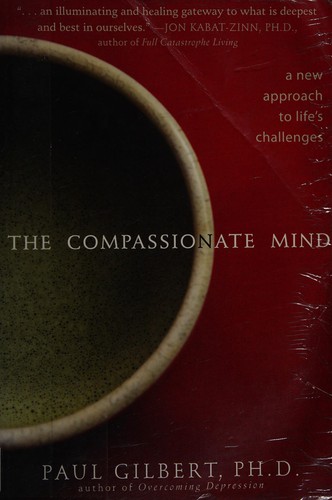
Talk to The Compassionate Mind like its author wrote you back.
Get the ideas that fit your life — not generic summaries.
- Chat with the book
- Audiobook-style main ideas
- Adapts to your life and goals
- Helps you take action
What it argues
The Compassionate Mind is Paul Gilbert's comprehensive account of Compassion Focused Therapy, the approach he developed over decades of clinical work with people whose suffering was heavily compounded by shame, self-criticism, and an inability to feel comforted or to comfort themselves. Gilbert, a clinical psychologist at the University of Derby, argues that modern humans face a fundamental mismatch: we evolved ancient threat-detection and competitive social systems in an environment where they served survival, but those same systems now misfire in modern life with consequences for mental health that are both widespread and poorly addressed.
The book is structured around an evolutionary model of the mind. Gilbert describes three evolved systems that regulate emotion and motivation: the threat-protection system (anxiety, anger, disgust), the drive and acquisition system (desire, excitement, ambition), and the contentment and affiliation system (calm, warmth, belonging). He argues that contemporary culture over-activates the first two and chronically under-activates the third. People know how to want things and how to fear threats; they have much less practice generating the kind of warm, soothing inner relationship that allows genuine self-care.
What it gets right
- 1.
The evolved human mind contains three distinct emotion-regulation systems: threat, drive, and contentment-affiliation. Modern life systematically overuses the first two and neglects the third.
- 2.
Shame is one of the most destructive human experiences because it targets the entire self rather than a behavior. People organized around shame avoid, hide, and attack themselves in ways that perpetuate suffering.
- 3.
Self-criticism activates the threat system, flooding the body with cortisol and preparing for defense or escape. It is physiologically the opposite of the conditions needed for reflection and change.
What it covers
Who wrote it
Paul Gilbert is Professor of Clinical Psychology at the University of Derby and a Fellow of the British Psychological Society. He developed Compassion Focused Therapy in the 1980s and 1990s while working with patients whose depression and anxiety were dominated by shame and self-criticism. He has published extensively in academic journals and is the author of several books including Overcoming Depression and The Compassionate Mind Workbook. He was appointed to an Order of the British Empire in 2011 for services to mental health. His work draws on evolutionary psychology, neuroscience, Buddhist philosophy, and attachment theory.
