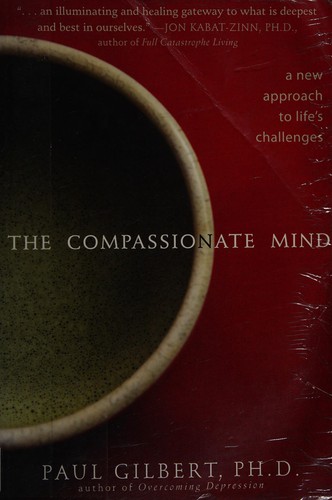
The Compassionate Mind by Paul Gilbert is a 2009 psychology book about self-compassion, shame, emotional regulation. The evolved human mind contains three distinct emotion-regulation systems: threat, drive, and contentment-affiliation. Modern life systematically overuses the first two and neglects the third.
Summary
The Compassionate Mind is Paul Gilbert's comprehensive account of Compassion Focused Therapy, the approach he developed over decades of clinical work with people whose suffering was heavily compounded by shame, self-criticism, and an inability to feel comforted or to comfort themselves. Gilbert, a clinical psychologist at the University of Derby, argues that modern humans face a fundamental mismatch: we evolved ancient threat-detection and competitive social systems in an environment where they served survival, but those same systems now misfire in modern life with consequences for mental health that are both widespread and poorly addressed.
The book is structured around an evolutionary model of the mind. Gilbert describes three evolved systems that regulate emotion and motivation: the threat-protection system (anxiety, anger, disgust), the drive and acquisition system (desire, excitement, ambition), and the contentment and affiliation system (calm, warmth, belonging). He argues that contemporary culture over-activates the first two and chronically under-activates the third. People know how to want things and how to fear threats; they have much less practice generating the kind of warm, soothing inner relationship that allows genuine self-care.
Compassion Focused Therapy, which emerges from this analysis, trains people to activate the contentment and affiliation system deliberately. The core practices involve cultivating a compassionate inner voice — initially imagined as an idealized compassionate figure, then gradually internalized — and learning to direct that voice toward the self in moments of struggle. For people with high shame and self-criticism, this is not easy; the threat system often reads self-compassion as weakness or self-indulgence. Gilbert addresses this resistance at length, drawing on research in neuroscience, attachment theory, and evolutionary psychology.
The book is long and ambitious. Gilbert covers a great deal of ground — evolutionary biology, neuroscience, Buddhist psychology, developmental attachment — and synthesizes it coherently. The clinical applications are clear. It is best read by people who have experienced chronic shame or who work therapeutically with such clients; the general-interest reader will find it demanding but rewarding.
Talk to The Compassionate Mind like its author wrote you back.
Get the ideas that fit your life — not generic summaries.
- Chat with the book
- Audiobook-style main ideas
- Adapts to your life and goals
- Helps you take action
Key takeaways
- 1.
The evolved human mind contains three distinct emotion-regulation systems: threat, drive, and contentment-affiliation. Modern life systematically overuses the first two and neglects the third.
- 2.
Shame is one of the most destructive human experiences because it targets the entire self rather than a behavior. People organized around shame avoid, hide, and attack themselves in ways that perpetuate suffering.
- 3.
Self-criticism activates the threat system, flooding the body with cortisol and preparing for defense or escape. It is physiologically the opposite of the conditions needed for reflection and change.
- 4.
Compassion is not passive softness. Gilbert defines it as a sensitivity to suffering combined with a deep commitment to alleviate it — applied to oneself and others alike.
- 5.
Many people with high shame find self-compassion threatening. Feeling kindness toward oneself can trigger grief for what was not received in childhood, or feel like giving up the vigilance that felt protective.
- 6.
The compassionate mind practices use imagery and voice to deliberately activate the soothing-affiliation system. Like any mental skill, this requires training rather than intellectual understanding alone.
- 7.
Our 'tricky brain' can imagine, ruminate, and anticipate in ways no other species can — but it can also turn these capacities on themselves, generating suffering from internal criticism that has no external trigger.
- 8.
Compassion Focused Therapy has evidence for effectiveness with shame-based difficulties, eating disorders, psychosis, and depression — populations where standard cognitive-behavioral approaches have often been insufficient.
Discussion questions
Use these on your own, with a book club, or as chat starters in Superbook. Book club version, ready to copy or print →
- 1.
Gilbert argues that our evolved minds were not designed for happiness or well-being but for survival and reproduction. How does accepting that premise change how you think about your own mental struggles?
- 2.
Self-criticism often feels productive — like it's keeping you accountable. Gilbert says it activates threat rather than change. Have you experienced cases where self-criticism actually drove improvement, or did it only feel that way?
- 3.
Think of a moment when you were harshest on yourself. What would a genuinely compassionate response to that situation have looked like, and what stopped you from accessing it?
- 4.
Gilbert distinguishes between shame (about the self) and guilt (about behavior). Can you identify situations in your own life where these two got confused, and what effect that had?
- 5.
The book argues that many people find self-compassion threatening because it requires grieving what was not received early in life. How does developmental history shape a person's capacity for self-care as an adult?
- 6.
Contemporary culture prizes drive and ambition — the acquisition system. Which of Gilbert's three systems does your life most reward, and which does it most ignore?
- 7.
If you tried to imagine a genuinely compassionate inner voice, what would it say to you right now? What makes that exercise feel strange or uncomfortable?
- 8.
Gilbert uses evolutionary biology to explain why the human mind is so prone to suffering. Does that explanation make suffering feel more or less tractable to you?
- 9.
Compassionate Focused Therapy was developed partly for people with high shame who responded poorly to standard CBT. What does it suggest about the limits of approaches that focus only on changing thought content?
- 10.
The practices in the book — imagery, voice training, body-based soothing — require repetition and are not primarily intellectual. What barriers exist in your own life to engaging with that kind of practice?
- 11.
Gilbert draws on Buddhist psychology alongside Western clinical science. Does the combination strengthen or dilute each tradition for you?
- 12.
Who in your life models genuine compassion — toward themselves as well as others? What makes that quality rare?
Themes
Frequently asked questions
-
What is Compassion Focused Therapy?
CFT is a psychological therapy developed by Paul Gilbert for people whose difficulties are strongly driven by shame and self-criticism. It uses evolutionary psychology and neuroscience to explain why the human mind defaults to threat and self-attack, and trains compassion as an antidote through specific practices targeting the body, imagery, and inner voice.
-
Is The Compassionate Mind a self-help book or a clinical text?
It is both. Gilbert wrote it for a general audience as well as clinicians. The theoretical sections are dense; the practical sections include exercises anyone can use. People who are working with a therapist will get more from it than those reading entirely alone.
-
How is compassion different from self-pity or weakness?
Gilbert addresses this directly. Compassion involves clearly seeing suffering and committing to act to alleviate it. Self-pity stays with the feeling without moving toward action. Strength and courage are part of Gilbert's definition of compassion — particularly the courage to face painful feelings directly.
-
How long does it take to read The Compassionate Mind?
The book is around 500 pages and takes six to eight hours to read. Given its density and the value of pausing to work with the exercises, most readers benefit from reading it over several weeks rather than straight through.
-
Who should read this book?
People who experience intense self-criticism, chronic shame, or who have found that knowing what to do doesn't translate into doing it. It is also very useful for therapists working with shame-based presentations, eating disorders, or trauma.