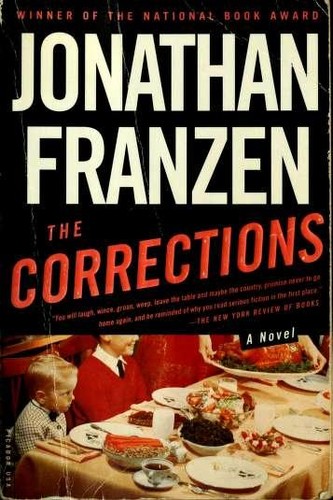
Talk to The Corrections like its author wrote you back.
Get the ideas that fit your life — not generic summaries.
- Chat with the book
- Audiobook-style main ideas
- Adapts to your life and goals
- Helps you take action
The Corrections, in detail
Jonathan Franzen's third novel, published in 2001 and winner of the National Book Award, follows the Lambert family across three adult children and their aging parents, Alfred and Enid, through the late 1990s. Enid wants one last family Christmas at the family home in the fictional Midwestern city of St. Jude before Alfred's Parkinson's disease makes everything impossible. The novel cuts between each family member's plotline — Chip in New York burning his academic career; Gary in Philadelphia managing his depression and his difficult marriage; Denise in Philadelphia cooking her way through professional success and personal wreckage — before drawing them all back to St. Jude for the ending.
The novel is structurally traditional — omniscient third person, recognizable family drama — but it operates at a much higher temperature than most family novels. Franzen brings a Dickensian appetite for social satire (dot-com excess, pharmaceutical cures for everything, the managed-care infantilization of the old) and a Tolstoyan commitment to interiority: every major character gets a long, unflinching passage inside their own head. Alfred's Parkinson's chapters are the most formally audacious sections, depicting a mind losing its grip on reality in prose that destabilizes accordingly.
The novel's weight is in its emotional precision. Franzen is merciless about the gap between who the Lamberts think they are and who they actually are — about how self-deception works in intelligent people who can see everyone else's self-deception clearly. Enid and Alfred are the novel's moral center, not because they're admirable but because their losses are real and Franzen insists on taking them seriously. This is a book about the difficulty of family — not the sentimentalized difficulty, but the specific, particular horror of sharing a history with people you didn't choose and can't leave.
At six hundred pages it's a long book, and the middle section set in Lithuania will divide readers — some find it brilliant, others find it the novel's most indulgent passage. But the last hundred pages are among the best Franzen wrote, and the final image of Enid, after everything, is devastating in a way that earns all the preceding length.
The big ideas
- 1.
The Lamberts each carry a version of the family's pathologies — control, denial, performance — while being unable to see this clearly in themselves.
- 2.
Alfred's Parkinson's gives the novel its emotional spine: the horror of watching a difficult father become vulnerable is something Franzen refuses to make sentimental.
- 3.
Franzen treats the 1990s prosperity and its technologies — Prozac, the dot-com boom, managed-care psychiatry — as a backdrop of managed unreality against which the family's actual suffering plays out.
