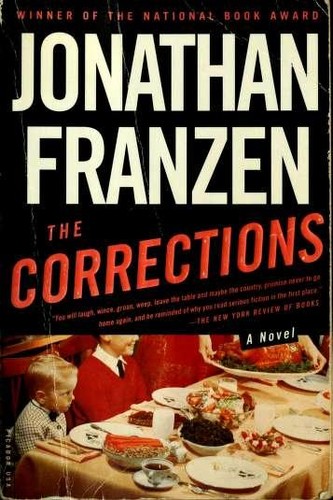
The Corrections by Jonathan Franzen is a 2001 literary fiction book about family dysfunction, american consumerism, aging and decline. The Lamberts each carry a version of the family's pathologies — control, denial, performance — while being unable to see this clearly in themselves.
Summary
Jonathan Franzen's third novel, published in 2001 and winner of the National Book Award, follows the Lambert family across three adult children and their aging parents, Alfred and Enid, through the late 1990s. Enid wants one last family Christmas at the family home in the fictional Midwestern city of St. Jude before Alfred's Parkinson's disease makes everything impossible. The novel cuts between each family member's plotline — Chip in New York burning his academic career; Gary in Philadelphia managing his depression and his difficult marriage; Denise in Philadelphia cooking her way through professional success and personal wreckage — before drawing them all back to St. Jude for the ending.
The novel is structurally traditional — omniscient third person, recognizable family drama — but it operates at a much higher temperature than most family novels. Franzen brings a Dickensian appetite for social satire (dot-com excess, pharmaceutical cures for everything, the managed-care infantilization of the old) and a Tolstoyan commitment to interiority: every major character gets a long, unflinching passage inside their own head. Alfred's Parkinson's chapters are the most formally audacious sections, depicting a mind losing its grip on reality in prose that destabilizes accordingly.
The novel's weight is in its emotional precision. Franzen is merciless about the gap between who the Lamberts think they are and who they actually are — about how self-deception works in intelligent people who can see everyone else's self-deception clearly. Enid and Alfred are the novel's moral center, not because they're admirable but because their losses are real and Franzen insists on taking them seriously. This is a book about the difficulty of family — not the sentimentalized difficulty, but the specific, particular horror of sharing a history with people you didn't choose and can't leave.
At six hundred pages it's a long book, and the middle section set in Lithuania will divide readers — some find it brilliant, others find it the novel's most indulgent passage. But the last hundred pages are among the best Franzen wrote, and the final image of Enid, after everything, is devastating in a way that earns all the preceding length.
Talk to The Corrections like its author wrote you back.
Get the ideas that fit your life — not generic summaries.
- Chat with the book
- Audiobook-style main ideas
- Adapts to your life and goals
- Helps you take action
Key takeaways
- 1.
The Lamberts each carry a version of the family's pathologies — control, denial, performance — while being unable to see this clearly in themselves.
- 2.
Alfred's Parkinson's gives the novel its emotional spine: the horror of watching a difficult father become vulnerable is something Franzen refuses to make sentimental.
- 3.
Franzen treats the 1990s prosperity and its technologies — Prozac, the dot-com boom, managed-care psychiatry — as a backdrop of managed unreality against which the family's actual suffering plays out.
- 4.
Each of the three children has a different strategy for escaping the family's emotional patterns, and the novel shows all three strategies failing.
- 5.
The 'corrections' of the title operate on multiple levels: market corrections, behavioral corrections, the family's constant attempt to correct itself into a shape it can tolerate.
- 6.
Enid is initially the novel's most frustrating character and by the end its most moving — the shift is one of Franzen's real achievements.
- 7.
The novel is explicitly a social novel in the tradition of Dickens and Tolstoy, attempting to put an entire American cultural moment into a family story.
- 8.
Franzen's prose can be cruel — he sees his characters' flaws with surgical clarity — but the cruelty coexists with genuine compassion, especially for the parents.
Discussion questions
Use these on your own, with a book club, or as chat starters in Superbook. Book club version, ready to copy or print →
- 1.
Enid is often read as the novel's villain — controlling, emotionally manipulative, unable to acknowledge Alfred's condition. By the end, do you still feel that way? What changes?
- 2.
Alfred is brilliant, difficult, and losing his mind. The novel asks you to grieve for him without quite liking him. Did it work for you?
- 3.
Each of the children has escaped St. Jude and built lives defined partly by what they're not. Which of the three do you think has made the most honest accounting of their inheritance?
- 4.
The Lithuanian section is the most stylistically unusual part of the book — Chip's picaresque adventure. Does it belong? What would the novel lose if it were cut?
- 5.
Franzen is satirizing the 1990s cultural moment — Prozac solving everything, the dot-com gold rush, the medicalization of behavior. Does that satire feel dated, or does it land as intended?
- 6.
The novel was accused of condescension toward Midwestern values. Is that criticism fair? Or is Franzen's portrait of St. Jude more complicated than that?
- 7.
The title is doing a lot of work. By the end, whose 'corrections' did you find most meaningful — Gary's, Chip's, Denise's, Enid's?
- 8.
Franzen gave a famous interview expressing ambivalence about Oprah's Book Club selection, which created a controversy about the audience for literary fiction. How does that context affect how you read the novel's ambitions?
- 9.
The last few pages, after the Christmas, are very spare compared to the novel's usual density. Why does the tonal shift work, or why doesn't it?
- 10.
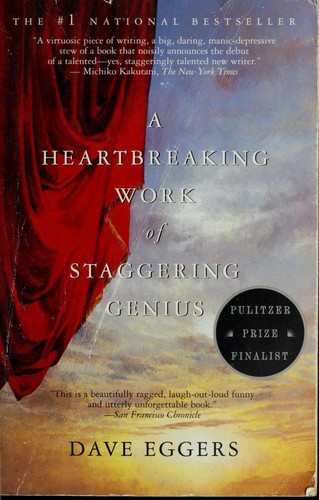
Compared to a family novel like A Heartbreaking Work of Staggering Genius — also from around the same period — what is Franzen doing differently? Which is more honest about family?
- 11.
The novel is six hundred pages. Could it have been shorter? What would you cut?
- 12.
Alfred's hallucinations and dementia are rendered in prose that becomes formally unstable. Is that a gimmick or does it earn its difficulty?
Themes
Frequently asked questions
-
Is The Corrections worth 600 pages?
If you like family novels with serious literary ambition, yes. If you need narrative momentum or a plot that drives forward, probably not — Franzen is interested in accumulation and psychology, not incident. The last hundred pages justify the length for most readers who make it there.
-
Is The Corrections depressing?
It's dark in the way that honest family fiction is dark — it shows people failing to connect, declining, self-deceiving. But it's also very funny in places, and the ending, while not happy, is not despairing either. Bleak is more accurate than depressing.
-
Who is the main character?
All five Lamberts have significant sections, but Enid and Alfred are arguably the emotional center. Chip has the most dramatic plot. Denise has the most interior depth. Gary has the most relatable self-deception.
-
Do I need to have read Franzen's earlier novels?
No. The Corrections is completely self-contained and is by far his most accessible book.
-
Who shouldn't read this book?
Readers who find Midwestern family drama uninteresting, or who are repelled by long novels about people who are mostly wrong about themselves. Also, if you are currently having a difficult time with a parent's dementia, this may be too close to home.
Similar books
A Heartbreaking Work of Staggering Genius
Dave Eggers
The Year of Magical Thinking
Joan Didion
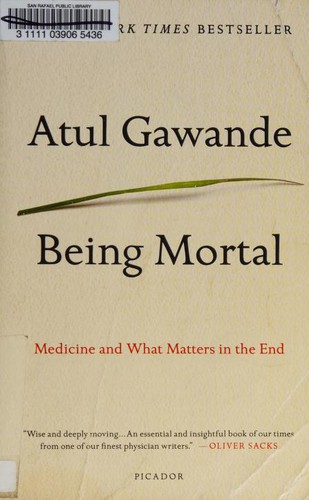
Being Mortal: Medicine and What Matters in the End
Atul Gawande
Man's Search for Meaning
Viktor E. Frankl
