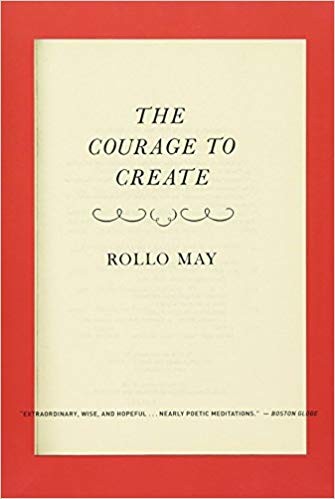
Talk to The Courage to Create like its author wrote you back.
Get the ideas that fit your life — not generic summaries.
- Chat with the book
- Audiobook-style main ideas
- Adapts to your life and goals
- Helps you take action
What it argues
The Courage to Create is Rollo May's sustained argument that creativity is not a talent but an act of courage — specifically, the courage to encounter reality directly, to bring something new into the world against the resistance of both the external environment and one's own anxiety. May draws on existential philosophy, clinical psychology, and his own experience as a writer and therapist to develop a theory of creativity that refuses the Romantic cliché of the inspired artist and the behavioral-science reduction of creativity to problem-solving.
Central to May's account is the concept of the encounter. Creativity happens in the charged space between the artist and the material — whether that material is paint, language, a scientific problem, or a human relationship. The encounter is not passive absorption but an intense, sometimes frightening engagement. May argues that anxiety is not the enemy of creativity but its necessary companion. The artist who waits until the anxiety passes will never begin. Creativity requires choosing the encounter despite the fear.
What it gets right
- 1.
Creativity is not a talent or a mood — it is an act of courage. The courage to engage directly with what is real, even when that engagement produces anxiety.
- 2.
The encounter is the creative moment: the charged, active meeting between the person and the material, the problem, or the world. Passive observation produces nothing new.
- 3.
Anxiety is not the enemy of creativity but its companion. The creative act moves forward despite anxiety, not after it disappears.
What it covers
Who wrote it
Rollo May (1909–1994) was an American existential psychologist and one of the most widely read figures in the humanistic psychology movement. He studied with Alfred Adler in Vienna and with Paul Tillich at Union Theological Seminary. His books include The Meaning of Anxiety, Man's Search for Himself, and Love and Will, which won the National Book Award in 1970. The Courage to Create, published in 1975, grew out of a series of lectures at Yale. May practiced as a therapist for decades and brought unusual literary and philosophical depth to the field of clinical psychology.
