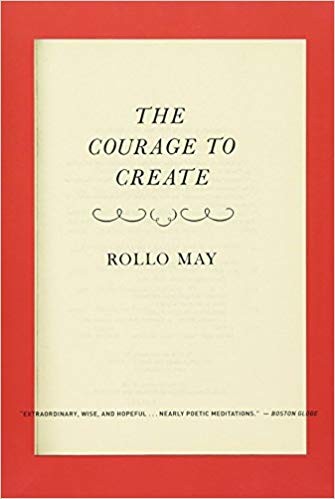
The Courage to Create by Rollo May is a 1975 philosophy book about creativity, courage, anxiety. Creativity is not a talent or a mood — it is an act of courage. The courage to engage directly with what is real, even when that engagement produces anxiety.
Summary
The Courage to Create is Rollo May's sustained argument that creativity is not a talent but an act of courage — specifically, the courage to encounter reality directly, to bring something new into the world against the resistance of both the external environment and one's own anxiety. May draws on existential philosophy, clinical psychology, and his own experience as a writer and therapist to develop a theory of creativity that refuses the Romantic cliché of the inspired artist and the behavioral-science reduction of creativity to problem-solving.
Central to May's account is the concept of the encounter. Creativity happens in the charged space between the artist and the material — whether that material is paint, language, a scientific problem, or a human relationship. The encounter is not passive absorption but an intense, sometimes frightening engagement. May argues that anxiety is not the enemy of creativity but its necessary companion. The artist who waits until the anxiety passes will never begin. Creativity requires choosing the encounter despite the fear.
May also explores the relationship between creativity and the daemonic — the term he uses throughout his work for the primal forces of life that can be creative or destructive. The daemonic is what drives the artist to keep working past comfort and convention. It is also what can overwhelm the person who has no conscious relationship to it. Integration, not suppression, is the path to creative health.
The book is short but conceptually rich. May never reduces creativity to a technique or a set of habits. His insistence that genuine creative work involves risk, vulnerability, and the willingness to be changed by the encounter makes the book uncomfortable in useful ways. It is most valuable for people engaged in work that requires original thought — not just artists in the conventional sense, but scientists, therapists, educators, and anyone who takes seriously the task of bringing something genuine into the world.
Talk to The Courage to Create like its author wrote you back.
Get the ideas that fit your life — not generic summaries.
- Chat with the book
- Audiobook-style main ideas
- Adapts to your life and goals
- Helps you take action
Key takeaways
- 1.
Creativity is not a talent or a mood — it is an act of courage. The courage to engage directly with what is real, even when that engagement produces anxiety.
- 2.
The encounter is the creative moment: the charged, active meeting between the person and the material, the problem, or the world. Passive observation produces nothing new.
- 3.
Anxiety is not the enemy of creativity but its companion. The creative act moves forward despite anxiety, not after it disappears.
- 4.
The daemonic — the primal, undirected life-force — drives creative work. It must be acknowledged and integrated, not suppressed or surrendered to.
- 5.
Originality requires the willingness to stand against the current — against convention, against the approval of others, against one's own previous habits and beliefs.
- 6.
Insight tends to arrive not during sustained effort but after it — in moments of relaxation, walking, or waking. Preparation and incubation precede illumination.
- 7.
Form and spontaneity are not opposites. The constraints of form — meter, structure, the limits of the medium — create the tension that makes genuine expression possible.
- 8.
The creative act is ultimately an affirmation of being. It says: this matters, this is worth bringing into existence, despite the indifference of the universe.
Discussion questions
Use these on your own, with a book club, or as chat starters in Superbook. Book club version, ready to copy or print →
- 1.
May argues that creativity requires courage, not talent. Where in your own creative work do you most feel that courage is what's actually being tested?
- 2.
Describe an encounter — with a problem, a piece of work, another person — where the engagement was genuinely transformative. What made it different from less charged interactions?
- 3.
May says anxiety accompanies the creative act and cannot be avoided. How do you currently respond to creative anxiety, and does May's reframing change anything for you?
- 4.
Where in your life are you waiting for the anxiety to pass before beginning something? What would it mean to begin anyway?
- 5.
May argues that genuine creativity requires standing against the crowd, including the crowd of one's own previous opinions. Where have you felt that resistance, and how did you respond to it?
- 6.
The daemonic in May's sense — the raw life-force that can be creative or destructive — shows up in everyone. How do you experience it, and what is your relationship to it?
- 7.
May says form enables rather than restricts genuine expression. Do you agree? Where have constraints helped rather than hindered your best work?
- 8.
Insight tends to arrive in gaps — after effort, not during it. How do you create those gaps in your own work and thinking?
- 9.
May insists that creativity is about bringing something genuine into the world, not producing something that looks creative. Where in your life do you perform creativity rather than practice it?
- 10.
What would you create if you genuinely were not seeking approval? How different would it be from what you currently produce?
- 11.
May treats courage as a psychological and philosophical category, not just a moral one. Does that framing change how you think about what it means to be brave?
Themes
Frequently asked questions
-
What is The Courage to Create about?
It is Rollo May's philosophical examination of creativity — what it requires, what it costs, and why it matters. May argues that creativity is fundamentally an act of courage: the willingness to encounter reality directly and bring something new into existence despite anxiety and resistance.
-
Is The Courage to Create worth reading?
Yes, especially for anyone engaged in creative work who finds standard productivity advice insufficient. May treats creativity as a philosophical and existential matter, not a set of habits to optimize. The book is short and dense, and its central insights hold up well.
-
Who should read The Courage to Create?
Writers, artists, scientists, therapists, educators — anyone whose work requires original thought and who has noticed that the obstacles to it are psychological as much as practical. It is not a how-to book. It is a book about what creative work actually demands of a person.
-
How long does it take to read The Courage to Create?
About three to four hours at average reading pace. The book is relatively short — under 180 pages in most editions — but the argument is dense and benefits from slow reading and reflection.
-
What is the main difference between May's view of creativity and more popular accounts?
May refuses to make creativity comfortable. He insists it is inseparable from anxiety, risk, and the willingness to stand against convention. Popular accounts tend to treat creativity as a resource to unlock or a habit to build. May treats it as a confrontation with the difficulty of being alive.
Similar books
Man's Search for Meaning
Viktor E. Frankl
Big Magic
Elizabeth Gilbert
The War of Art
Steven Pressfield
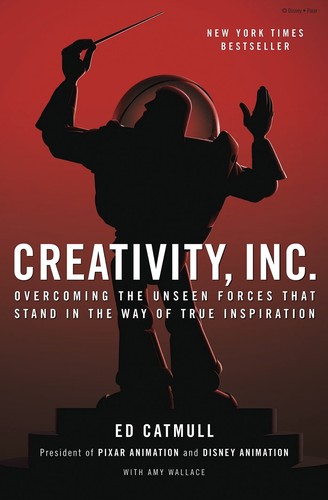
Creativity, Inc.: Overcoming the Unseen Forces That Stand in the Way of True Inspiration
Ed Catmull and Amy Wallace
