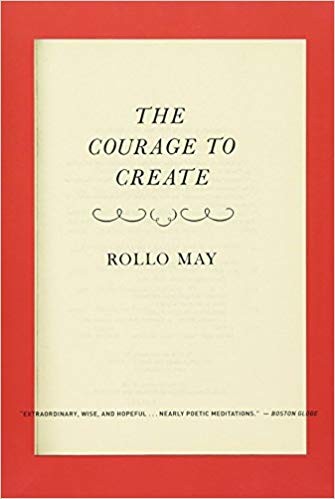
Talk to The Courage to Create like its author wrote you back.
Get the ideas that fit your life — not generic summaries.
- Chat with the book
- Audiobook-style main ideas
- Adapts to your life and goals
- Helps you take action
The Courage to Create, in detail
The Courage to Create is Rollo May's sustained argument that creativity is not a talent but an act of courage — specifically, the courage to encounter reality directly, to bring something new into the world against the resistance of both the external environment and one's own anxiety. May draws on existential philosophy, clinical psychology, and his own experience as a writer and therapist to develop a theory of creativity that refuses the Romantic cliché of the inspired artist and the behavioral-science reduction of creativity to problem-solving.
Central to May's account is the concept of the encounter. Creativity happens in the charged space between the artist and the material — whether that material is paint, language, a scientific problem, or a human relationship. The encounter is not passive absorption but an intense, sometimes frightening engagement. May argues that anxiety is not the enemy of creativity but its necessary companion. The artist who waits until the anxiety passes will never begin. Creativity requires choosing the encounter despite the fear.
May also explores the relationship between creativity and the daemonic — the term he uses throughout his work for the primal forces of life that can be creative or destructive. The daemonic is what drives the artist to keep working past comfort and convention. It is also what can overwhelm the person who has no conscious relationship to it. Integration, not suppression, is the path to creative health.
The book is short but conceptually rich. May never reduces creativity to a technique or a set of habits. His insistence that genuine creative work involves risk, vulnerability, and the willingness to be changed by the encounter makes the book uncomfortable in useful ways. It is most valuable for people engaged in work that requires original thought — not just artists in the conventional sense, but scientists, therapists, educators, and anyone who takes seriously the task of bringing something genuine into the world.
The big ideas
- 1.
Creativity is not a talent or a mood — it is an act of courage. The courage to engage directly with what is real, even when that engagement produces anxiety.
- 2.
The encounter is the creative moment: the charged, active meeting between the person and the material, the problem, or the world. Passive observation produces nothing new.
- 3.
Anxiety is not the enemy of creativity but its companion. The creative act moves forward despite anxiety, not after it disappears.
