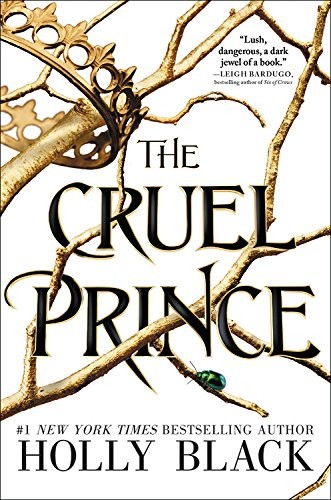
The Cruel Prince by Holly Black is a 2018 fantasy book about power and powerlessness, belonging between worlds, desire vs. self-preservation. Jude's desire to belong in a world that won't accept her drives every decision she makes, and Black shows how that desire can be weaponized against her by people who understand it.
Summary
When Jude was seven, her mortal parents were killed by a faerie general who then took her and her sisters to live in the treacherous world of Faerie. Ten years later, Jude wants nothing more than to belong — to earn her place in a world that views her as lesser by blood, to have power and standing in a court that considers mortals disposable. The thing standing most clearly in her way is Cardan, the youngest prince, who seems to make it his personal project to remind Jude what she is.
The Cruel Prince is political fantasy wrapped in an enemies-to-something romance, but calling it a romance undersells the book's real interest: power. Who has it, what it costs, and what a person without it is willing to do to get some. Jude is not a passive protagonist who discovers she is special — she is calculating, determined, and often brutal, and Black is interested in showing the cost of that calculation on her interiority. The fae politics are surprisingly intricate for a YA novel, and the scheming in the second half moves with real momentum.
Black has spent her career writing fae fiction, and her Faerie is not the pastoral variety. It is corrupt, status-obsessed, structured around hierarchy and cruelty, and genuinely dangerous to the human girls at its edges. The worldbuilding draws on genuine folk tradition rather than invented mythology, which gives the setting an earthy, specific quality. The prose is clean and fast.
The ideal reader is someone who wants a protagonist who fights dirty and earns her wins through cunning rather than virtue, set in a beautifully realized dark-fairy-tale world. Readers who prefer straightforward heroines or find morally grey romantic leads distasteful will not find this welcoming. The ending is a genuine surprise, and the rest of the trilogy (The Wicked King, The Queen of Nothing) is worth reading through. The first book stands alone well enough, but it reads best as the opening act of a complete story.
Talk to The Cruel Prince like its author wrote you back.
Get the ideas that fit your life — not generic summaries.
- Chat with the book
- Audiobook-style main ideas
- Adapts to your life and goals
- Helps you take action
Key takeaways
- 1.
Jude's desire to belong in a world that won't accept her drives every decision she makes, and Black shows how that desire can be weaponized against her by people who understand it.
- 2.
The fae cannot lie, but they manipulate constantly through omission, implication, and technically-true statements. The book uses this to make deception into a formal art form.
- 3.
The dynamic between Jude and Cardan works because Black keeps the power asymmetry honest — Cardan's cruelty is real, not just a misunderstanding, and Jude's response to it is not forgiveness.
- 4.
Politics in The Cruel Prince is treated as a skill set, not a backdrop. Jude learns to scheme, and the lessons are specific rather than vague.
- 5.
The mortal/fae divide maps loosely onto class and immigrant experience — the permanent outsider who has learned the culture but can never fully belong. Black doesn't belabor this, but it's present.
- 6.
Cardan's cruelty and vulnerability are not separated into two phases — they coexist, which makes him more unsettling than a simple villain and more interesting than a misunderstood hero.
- 7.
The twist ending is genuinely earned. Looking back, the setup is all there. It's a rare case of a YA fantasy that respects its reader enough to hide its hand without cheating.
- 8.
Jude is willing to hurt people. This is not framed as a corruption arc but as a survival strategy, and Black is honest about the moral weight it carries.
Discussion questions
Use these on your own, with a book club, or as chat starters in Superbook. Book club version, ready to copy or print →
- 1.
Jude could have chosen a safer life outside Faerie's politics. Why doesn't she? What does the novel suggest she would lose by choosing safety?
- 2.
Cardan's bullying is positioned as the origin point of a later romantic tension. Does the book handle that transition honestly, or does it too easily rehabilitate him?
- 3.
The fae prohibition on lying creates a world where every true statement is potentially a manipulation. What does it do to Jude — and to the reader — to operate in that environment?
- 4.
Jude's sister Vivienne has been in Faerie longer and made different choices. What does her path represent as an alternative?
- 5.
Madoc loves Jude in his way. Does the novel treat that as sufficient, or does it interrogate the difference between love and possession?
- 6.
The YA label raises a question: is the darkness in this book appropriate for its implied audience, or does it exceed those conventions? Where do you draw the line?
- 7.
The ending repositions Jude as an agent rather than a subject of the story. Was that shift visible earlier, or does it feel retroactive?
- 8.
What does Faerie represent as a world built on hierarchy and beauty that kills? Is it a fantasy setting or a critique of something more contemporary?
- 9.
Jude is strategic about her emotions in a way many protagonists aren't — she weaponizes her own feelings. Does that make her more or less sympathetic?
- 10.
Which of the sisters has made the best choice, given everything? Is that even the right question to ask?
- 11.
Black writes fae fiction rooted in folk tradition rather than Tolkien-adjacent worldbuilding. How does that change the feel of the magical world compared to fantasy you've read before?
Themes
Frequently asked questions
-
Is The Cruel Prince worth reading?
Yes, especially if you're interested in fae fantasy, scheming protagonists, and enemies-to-something dynamics that keep the power games front and center. It's fast, smart, and genuinely surprising at the end. Probably the best-executed entry in the post-ACOTAR fae fantasy wave.
-
Is this a romance?
There's a slow-burn romantic tension between Jude and Cardan, but The Cruel Prince is primarily a political fantasy. The romance becomes more central in the later books. Don't come expecting a love story and you'll be pleasantly surprised by how much plotting is here.
-
Is it YA or adult fantasy?
Published as YA, but the content — political intrigue, morally complex characters, real violence, and a romantic lead with genuine flaws — reads as mature by any useful standard. Adults who enjoy YA fantasy will be comfortable here.
-
Do I need to read the whole trilogy?
The first book ends with a real cliffhanger and the full arc requires all three. The Wicked King (book 2) is widely considered the best of the three. The Queen of Nothing wraps things up but feels slightly rushed compared to the first two.
-
Who shouldn't read this?
Readers who need a morally clear romantic lead — Cardan is not redeemed before the interest begins. Also readers who find court politics tedious; this book has a lot of scheming, and it's not in the background.