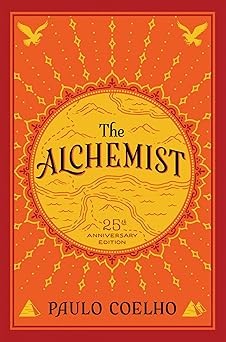
The Alchemist by Paulo Coelho is a 1988 religion & spirituality book about personal legend, destiny, omens. The Personal Legend is the unique purpose each person carries within them; the universe conspires to help those who pursue it and creates obstacles for those who flee it.
Summary
The Alchemist is a Brazilian novel first published in 1988 and translated into 80 languages, making it one of the most translated books in history. It tells the story of Santiago, a young Andalusian shepherd who dreams repeatedly of a treasure buried at the Egyptian pyramids and sets out to find it. Along the way he encounters a series of teachers and guides — a mysterious old king, a crystal merchant, an Englishman studying alchemy, and finally the alchemist himself — each of whom advances his education in what Coelho calls the Language of the World.
The novel's central concept is the Personal Legend — the unique purpose or destiny that each person carries within them and is called to fulfill. The universe conspires to help those who pursue their Personal Legend and creates obstacles for those who flee it. This is not a passive or deterministic doctrine: pursuing the Personal Legend requires courage, sacrifice, and repeated willingness to leave behind what is comfortable and familiar. The novel's emotional engine is the gap between the life one is already living and the life one was meant to live.
The spiritual teaching is woven through a simple narrative that draws on the parable tradition. Coelho is explicit about his sources: the alchemists as a metaphor for spiritual transformation, the desert as a mirror of the soul, the concept of the Soul of the World that connects all things. The theology is syncretic — it borrows from Christianity, Islam, and esoteric traditions without settling into any of them — and is perhaps best understood as a popular contemporary expression of the perennial philosophy.
The Alchemist has been criticized for its theological shallowness, its encouragement of a kind of magical thinking about destiny, and its reduction of complex spiritual traditions to an uplifting narrative. These criticisms are fair. But the book's power to motivate people to pursue meaningful lives — to leave the crystal merchant's comfort for the uncertain journey — has been documented by millions of readers for whom it arrived at exactly the right moment.
Talk to The Alchemist like its author wrote you back.
Get the ideas that fit your life — not generic summaries.
- Chat with the book
- Audiobook-style main ideas
- Adapts to your life and goals
- Helps you take action
Key takeaways
- 1.
The Personal Legend is the unique purpose each person carries within them; the universe conspires to help those who pursue it and creates obstacles for those who flee it.
- 2.
The Language of the World is the universal pattern underlying all phenomena — recognizable by those who have developed the capacity to read omens and listen deeply.
- 3.
The journey toward one's Personal Legend is always transformative: the traveler who returns is never the same person who set out.
- 4.
Pursuing one's destiny requires repeatedly leaving behind what is comfortable and familiar — the crystal merchant is a cautionary example of someone who chose safety over purpose.
- 5.
The Soul of the World connects all things; acting in alignment with this connection is what the alchemist tradition means by alchemy.
- 6.
The treasure at the end of the journey often turns out to be something discovered through the journey itself rather than what was originally imagined.
- 7.
Fear is the great obstacle to pursuing the Personal Legend — fear of failure, of loss, of the unknown — but the person who overcomes it discovers that the universe was waiting to help.
- 8.
The present moment — fully inhabited, attentively encountered — contains all the wisdom of the journey; much of the teaching is about learning to be where you are.
Discussion questions
Use these on your own, with a book club, or as chat starters in Superbook. Book club version, ready to copy or print →
- 1.
Do you believe you have a Personal Legend in Coelho's sense — a unique purpose you are called to fulfill? What makes you believe or doubt it?
- 2.
The crystal merchant chose security over his dream of seeing the pyramids. Is that portrayed fairly — as failure — or does it describe a legitimate choice?
- 3.
Coelho's theology holds that the universe conspires to help those pursuing their destiny. What would have to be true for that claim to be literally rather than metaphorically accurate?
- 4.
The novel is a parable, not a realistic narrative. What does the parable form allow that realistic fiction wouldn't? What does it prevent?
- 5.
Santiago leaves behind a comfortable life, a potential love, and a successful business in pursuit of his dream. Is that portrayed as admirable without qualification?
- 6.
The alchemist tells Santiago that most people abandon their Personal Legends in childhood and spend their lives not living. Is that a profound observation or a romantic exaggeration?
- 7.
Coelho draws on Christian, Islamic, and alchemical traditions simultaneously. Does that synthesis feel authentic or opportunistic?
- 8.
The treasure turns out to be near where Santiago started. Is that ending satisfying or a cheat? What is it supposed to teach?
- 9.
The novel has sold over 100 million copies worldwide. What does its extraordinary reach tell you about the hunger it is responding to?
- 10.
How does the concept of Personal Legend compare to secular concepts of purpose, vocation, or meaning-making?
- 11.
Is there a stage in your own life where you were the crystal merchant — comfortable, with a dream you were not pursuing? What happened?
Themes
Frequently asked questions
-
What is The Alchemist about?
A young shepherd named Santiago follows his dream — a recurring vision of treasure at the Egyptian pyramids — and undergoes a journey of spiritual education that teaches him about the nature of his Personal Legend, the Language of the World, and the Soul of the World.
-
Is The Alchemist actually philosophical?
It is philosophical in a popular rather than an academic sense — it offers a coherent worldview about destiny, meaning, and the nature of transformation, drawn from multiple spiritual traditions. It does not sustain rigorous philosophical analysis but it speaks to genuine human longings.
-
Why is The Alchemist so popular?
Because its central message — that you have a unique purpose, that pursuing it is possible and worthy, and that the universe will help you — answers a universal human longing for meaning and permission to pursue it. The simple narrative delivers that message with unusual emotional directness.
-
Is the novel appropriate for young readers?
Yes. It was originally intended for a broad audience and has been widely read by teenagers. Its themes of courage, purpose, and the willingness to leave comfort behind are especially resonant at life transitions.
-
What is the Personal Legend?
Coelho's term for the unique purpose each person was born to fulfill — their soul's deepest desire, which the universe conspires to help them achieve if they have the courage to pursue it and the attentiveness to recognize the omens that guide them.
Similar books
The Alchemist vs.
Deciding between two books? The Alchemist vs Siddhartha .
